
Hi, Andrey Mir is here. I am a media ecologist with 20+ years in journalism and a PhD in comm-cult. This archive is about old and new media and the future of humankind. For more regular updates, check out my Substack, Media Determinism. Twitter – @Andrey4Mir. To contact me, leave a comment below.
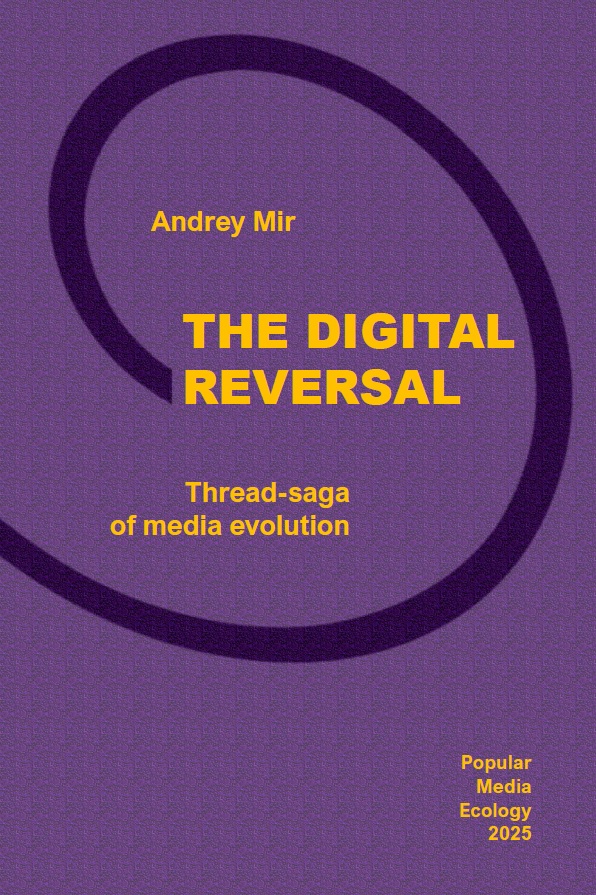
My latest book is The Digital Reversal. Thread-Saga of Media Evolution (2025). It’s about the Digital Reversal as the hallmark of the era, and the digital reversals that fuel it. According to McLuhan’s Laws of Media, any medium, when pushed to its limits or full potential, reverses its effects into their opposites. This is what we are experiencing now, as digital media 1) have sped up our interactions to ultimate, digital speed, 2) encompass nearly all areas of life, and 3) proliferate across all demographics and countries. Digital media are reaching their full potential—and this is the condition for reversal. That is why everything feels upside down and inside out: digital reversals flip everything into opposites.
I use the optic of reversal to examine old ideas, like postjournalism, digital orality, and the Viral Inquisitor, and to develop new ones, like intellectual escalation and gender reversal. The book explores digital reversals in bundles: reversals in media, reversals in values, epistemological reversals, sensory-cognitive reversals, cultural reversals, and the reversal of humankind itself.
To suit both digital orality and digital reversal, the book itself is a reversal—from the long, “monumental” writing of the 20th century to a more digital form: the entire book is written in tweets (1,295 of them), making it the first “tweetise” in history—a reversal of the treatise.
The Viral Inquisitor and other essays on postjournalism and media ecology (2024). The essays in this collection explore various aspects of digital media shift, ranging from the competition between CNN and Fox News, the postjournalism of generative AI, and platforms enslaving users while serving them, to political polarization, the shifting epistemology of truth, and the impacts of screens on children.

Digital Future in the Rearview Mirror. Jaspers’ Axial Age and Logan’s Alphabet Effect (2024), argues that all contemporary disturbances are the outcomes of the reversal of literacy and retrieval of orality – in the form of digital orality. To explore this reversal and retrieval, the book looks back in history at how literacy replaced orality in the past. The idea is that digital media are now replaying this process backward.

Postjournalism and the death of newspapers. The media after Trump: manufacturing anger and polarization (2020), explores the political-economic roots of post-truth and polarization in the news media. Available on Amazon:
Human as media. The emancipation of authorship (2014) introduced the concepts of authorship as a duty and the Viral Editor. It explores the development of online activities into political activism in the early 2010s.

Background: I worked as an editor in the business press in the 1990-2000s. After leaving the game in 2010, I specialized in media research and consulting. I am a Fulbright-Kennan scholar (Wilson Center in Washington, DC, 2012-13), a member of the Media Ecology Association and so on and so forth. I hold a PhD in communication and culture, with my thesis centered on applying media ecology and the political economy of communication to analyzing the news industry. My first dissertation, in journalism and linguistics, focused on the semantics of the Soviet media and propaganda (1996). My books, talks, and publications cover old and new media in the areas of linguistics, history, politics, corporate communication, journalism, and futurology.
Here is a thoughtful review of my work by William Kuhns in New Explorations: Mir-roring McLuhan in the digital era.
Below are other reviews of my books and some of my media appearances:
- We’ve got more content than ever. Why can’t we pay attention to it?
The Globe and Mail. Mark Kingwell, March 13, 2026. - «Le journalisme approche de son extinction historique». Ce qu’annonce Andrey Mir sur l’IA, les médias et la verité.
Upgrade Media. David Sallinen, March 12, 2026 - La vérification de l’information par chatbot interposé renforce à terme la polarisation de nos sociétés
Le Monde. Marion Seigneurin, January 11, 2025. - Dal giornalismo all’Inquisitore Virale
A review of The Viral Inquisitor in Italian. Media Duemila. Maria Pia Rossignaud, January 8, 2026. - Quantum ve kabile ruhu
(Eng: Quantum and tribal spirit. If I were to give an ‘out-of-the-box’ answer to the year-end cliché ‘Where are we going?’, I would mix media ecologist Andrey Mir with renowned economist Joseph Stiglitz.) Economi. Yaprak Özer, December 19, 2025. - Are we becoming post-literate?
The Spectator. Katherine Dee, November 18, 2025 - The Great Digital Reversal.
A review of “The Digital Reversal” in Revista Seúl by Eugenio Palopoli. November 2, 2025 - The Death of Gutenberg.
Is the rise of digital media causing the fall of literacy? A review of Andrey Mir’s Digital Future in the Rearview Mirror: Jaspers’ Axial Age and Logan’s Alphabet Effect. City Journal. Geoff Shullenberger, April 26, 2024. - The Fifth Wave: Andrey Mir takes on world history.
In Mir’s big new book, Digital Future in the Rearview Mirror, he explains how media made history and may soon end it. Discourse. Martin Gurri, February 20, 2024. - Forsker: Vi står midt i mediernes dødskamp
Flemming Rose har talt med Andrey Mir, som forsker i medier ved York University. Mir, der er forfatter til bøgerne “Human as Media: The Emancipation of Authorship” (2014) og “Postjournalism” (2020), siger at journalistik som vi kender det snart er slut. Frihedsbrevet. Flemming Rose, May 13, 2023. - It’s not Big Brother I fear but Huxley’s brave new world of mindless trivia. We’ve never had so much information at our fingertips — and so little wisdom to do anything useful with it. The Sunday Times. Matthew Syed, February 12, 2023.
- How the news business’s economics altered the news itself. Essayist Andrey Mir says media in a “post-journalism” world supply not news but “news validation.” The Washington Post. George F. Will, August 2, 2022.
- Az újságírásnak kedvező viszonyok eltűnőben Vannak. (“Favorable conditions for journalism are disappearing.” Interview with Andrey Mir.) 444.hu, Márton Bede, January 9, 2022.
- L’altro processo ai giornali. Il Foglio, Franco Debenedetti, Ottobre 23, 2021.
- Listening to a Herald of Doom. Liberty, Bruce Ramsey, September 1, 2021.
- Андрей Мирошниченко: «Редакционная политика, а не новости, — это и есть последний товар СМИ». Journalist, Всеволод Пуля, Сентябрь 2021.
- Things fall apart: why journalism might not survive what’s coming next. The Spinoff, Danyl Mclauchlan, August 21, 2021.
- The Press Now Depends on Readers for Revenue and That’s a Big Problem for Journalism. Discourse, Andrey Mir, July 28, 2021.
- How Economics Drives News Media. Andrey Mir’s Postjournalism offers a powerful, sweeping narrative of how news media have evolved over the centuries. EconLib, Arnold Kling, July 5, 2021.
- Чи можлива справжня журналістика в епоху повсюдної поляризації. В чому дослідник медіа Андрєй Мір бачить причину занепаду журналістики та що робити, аби не дозволити медіа та соцмережам поляризувати суспільство ще більше. Detector, Антон Процюк, 1 Липня 2021.
- Amerikanske medier tjente kassen på at dyrke Trump-hadet. Nu kommer problemerne. Politiken, Jens Lenler, May 16, 2021.
- Media Narratives and the Minds of the Masses. Pairagraph, May 10, 2021.
- “Post-Journalism” and the Death of News. Elites have lost control of the information agenda and, despite the “Trump bump,” they’re not getting it back. Discourse, Martin Gurri, April 13, 2021.
- Factoids and Fake News. Martin Gurri interviews Andrey Mir about the future of journalism. Discourse, April 13, 2021.
- How to live with polarisation. New Money Review, Paul Amery, March 19, 2021.
- Có hay không – “hậu báo chí”? Thế giới không phẳng. TTCT – Hết “hậu sự thật” (Post truth) nay người ta đang nói về “hậu báo chí” (Postjournalism). Nguyễn Vạn Phú, March 11, 2021.
- How both old and new media polarise society for profit (or survival). Why polarisation is a media effect and what we can do
about it. IPPR Progressive Review, Andrey Mir, Spring 2021. - How to Understand the Rage Economy. In “Postjournalism,” media ecologist Andrey Mir analyzes the way the news economy shapes our perceptions of reality. The Intercept, Murtaza Hussain, February 13, 2021.
- Slouching Toward Post-Journalism. City Journal, Martin Gurri, Winter 2021.
- How the world caught up with media visionary Marshall McLuhan. Post magazine, the South China Morning Post, Mike Hodgkinson, January 23, 2021.
And finally, here is my photo album of some memorable events and encounters.
 Human as Media
Hello Sir:
As a fellow Media Ecologist that knew Eric McLuhan, Mary and Andrew…I love your website and wish I could speak with you one day. I relate to everything on here. Great job. I wish I did a website half as good as this but…I have my reasons. Happy holidays to you and yours.
Re “The Dark Side of the Screen” and ‘There was no other rationale for the light mode.’: Some day you’ll be old enough to understand. Your eyes won’t accommodate to distance anymore. When you look at a bright surface your pupils contract, which makes the image on the retina sharper, so you can actually read the text. Everyone gets it eventually.
Do you plan on making your latest book The Digital Reversal. Thread-Saga of Media Evolution (2025) available to Canadian readers who have Kobo rather than Kindle ?
Sorry, it’s published on Amazon and available there. If Kindle is not a good option, they also have a paperback.
Hi Andrey, Who handles your translation rights?
Me
Hi again Andrey, I work for a Brazilian publisher where an editor is keen to consider your book – please email me to figure out who to proceed. Thanks – HS