The media ecology of math after AI
After Anthropic’s Levent Alpöge announced on November 20, 2026, that he had proved the Riemann Hypothesis with Claude, we seem to be approaching a pivotal moment in the development of AI that will change mathematics and the rest of civilization. I wrote about the possibility—or, rather, the inevitability—of such a development under the titles of the technological imperative and the acceleration of time (“told ya!”), and now the signs are starting to show. This is just the beginning; clearly, similar events will follow in the coming months, then at an even faster pace.
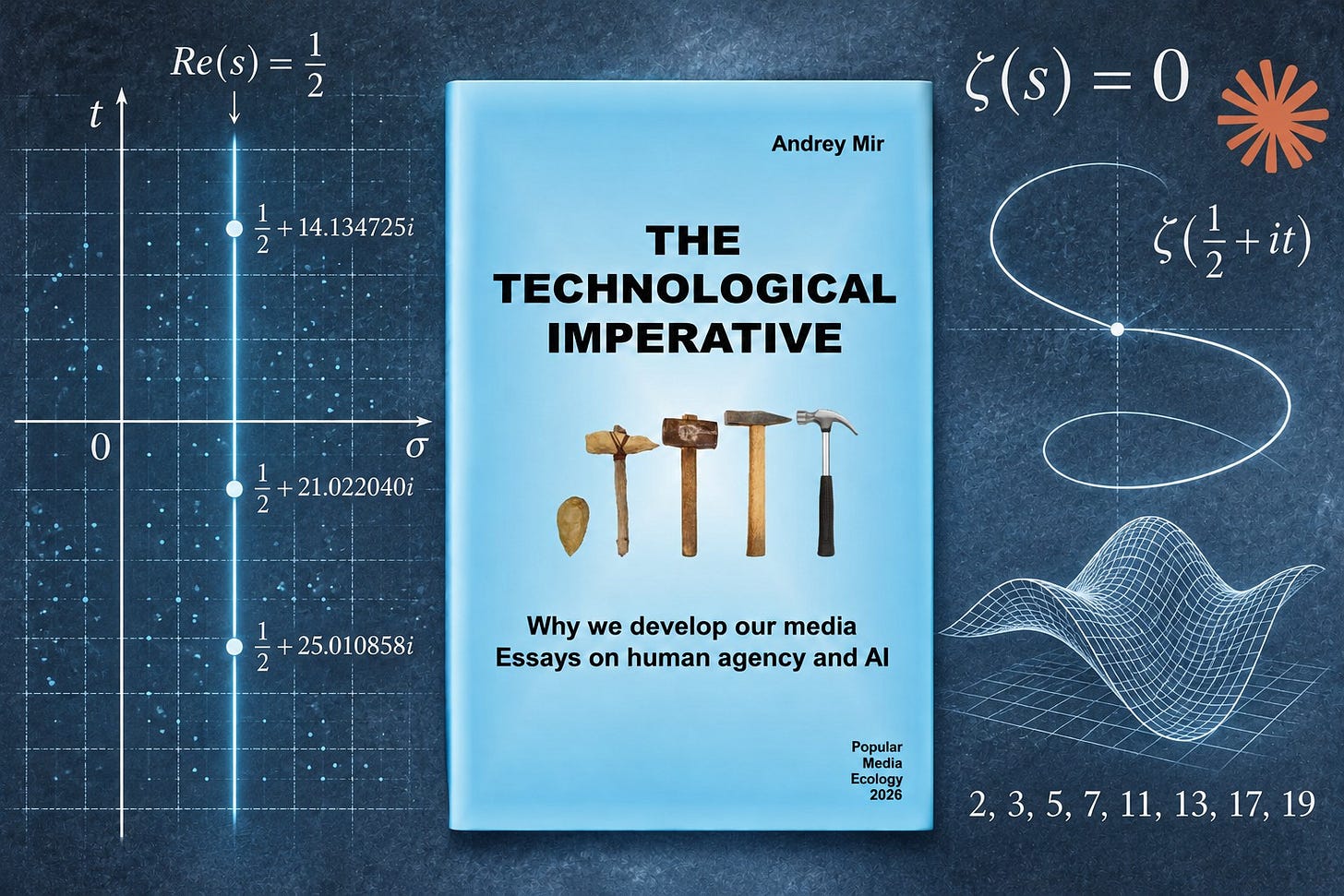
What the technological imperative is and what it says about AI
The technological imperative drives every medium toward better performance. Take the hammer: if we put all the historical forms of the hammer in a row, it will look as if some invisible designer has been searching for a better form to create the “proper,” ideal hammer as the best possible extension of the human arm and fist. This invisible designer is the technological imperative. It functions as the invisible hand of media evolution, directing the development of all media—what we humans perceive as technological progress.
(For more on the history of the technological imperative and its application to AI, see The Technological Imperative.)
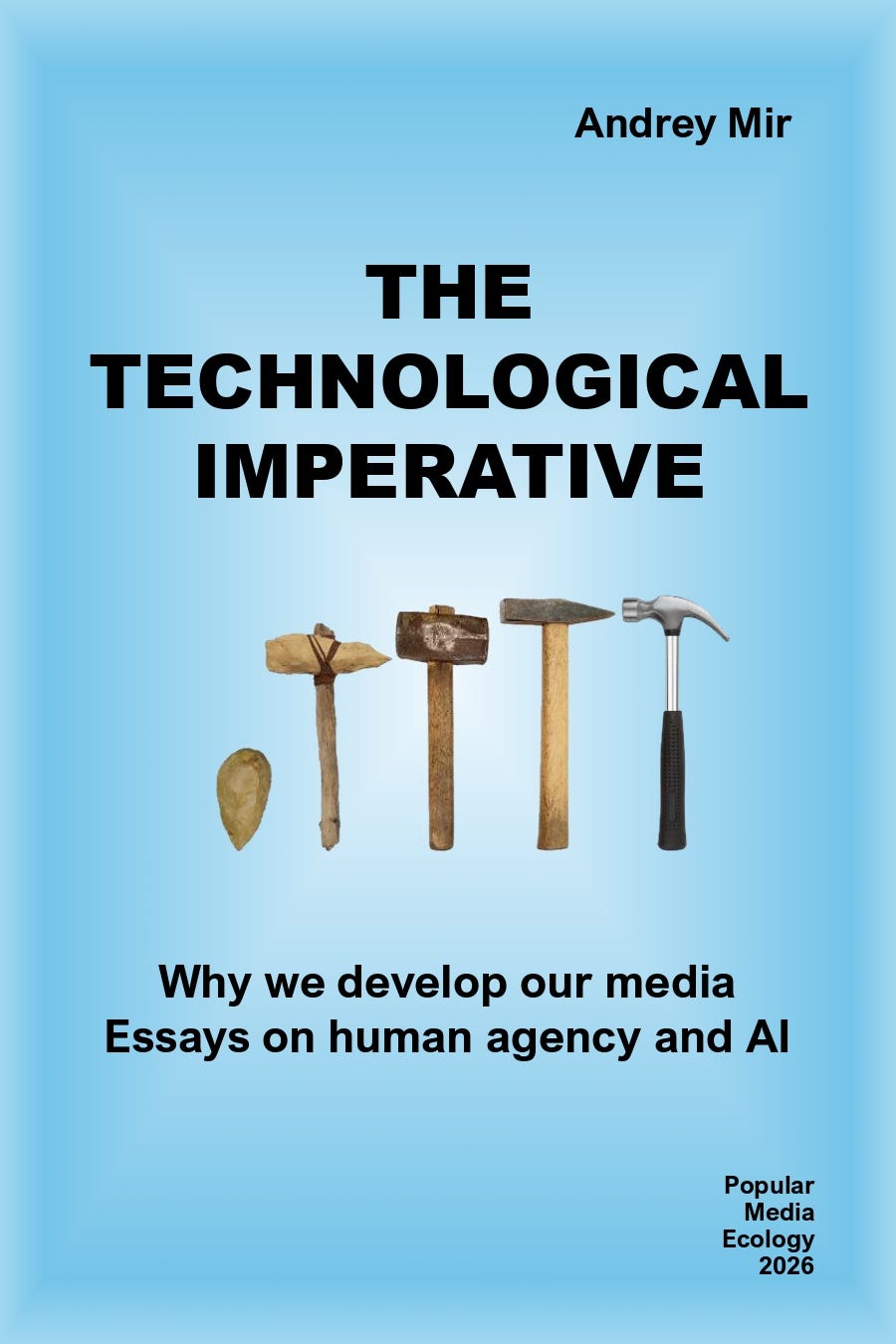
The technological imperative works through natural selection that we humans perform for media. As soon as a new technology emerges, we try to use it and its various modifications—and then we select and develop what works best. Through our countless attempts to use media, the technological imperative improves the performance of specific media, driving media evolution as a whole. The technological imperative is the formal cause of media evolution.
The technological imperative shows the true nature of our symbiotic relationship with media. Just as bees pollinate flowers in exchange for nectar, driving the evolution of plants, we develop our media toward their ideal forms in exchange for the nectar of the extensions they give us. As Marshall McLuhan said, humans are the sex organs of the machine world, just as bees are of the plant world.
What does the technological imperative say about AI? First of all, that all the debates about whether AI can or needs to acquire agency or consciousness are irrelevant. Artificial intelligence does not need agency to supersede human intelligence. The unsurpassed uniqueness of human cognition can be surpassed without agency—this is what AI is proving by proving the Riemann Hypothesis.
The technological imperative pushes every medium towards better performance in whatever this medium extends. AI extends human cognition. What is the ideal form, the ultimate extension of human cognition? Paul Levinson, a student of Neil Postman, introduced the evolutionary theory of media with the idea of media as human replay: media replay our natural faculties while extending them in time and space. So, media develop to replay our faculties—and eventually us—to the best of their abilities. What if they succeed? Imagine AI reaching its ideal form, the complete replay of cognition. It then has to reverse human replay into human replacement.
But even the total replay of human capacities—or of humans in their entirety—is not the end game, the “goal” of the technological imperative. Why stop at humans?
When Deep Blue defeated the best human chess player, it did not stop there. Why keep replaying humans if humans are outplayed? When the program had nothing left to learn from humans, it started learning from the rules of the game itself.
We seem to be approaching a similar threshold in another of the highest forms of our intellectual activity—mathematics. AI solves a problem that humans could not; moreover, humans cannot even understand the solution. Just like in chess, where AI now plays with the game itself, another AI now seems to be playing with mathematics itself.
The technological imperative offers a different, non-mathematical way to look at the latest development in math. Here are some media-ecological speculations on what the breakthrough with the Riemann Hypothesis reveals about AI, math, and humankind.
***
1. A reversal in “understanding” media
Ask not if AI can understand like humans do—ask if humans can understand what AI does.
2. No humans, no agency
The proof of the Riemann Hypothesis proves that AI does not need human agency to supersede humans. That means that our uniqueness as beings with consciousness and self-consciousness does not ensure our rule-making dominance in our relationship with AI.
3. A scientific truth that looks like a religious one
What is truth when the proof is there, but we cannot understand it? To us, it looks more like religious truth that rests on a leap of faith, not on scientific verification. Yet this AI solution does rely on formal verification and presumably already has it—but it’s simply beyond our comprehension.
We may be entering a world where we need to have faith in scientifically designed verification that we cannot understand. Humankind has never had this kind of truth and this kind of epistemology before.
4. The non-semantic language of AI
Human language represents things in their absence; signs standing for objects and concepts create a semantic copy of the world for our minds to work with. The lengthy and incomprehensible proof of the Riemann Hypothesis invites speculation that AI might develop a new way of communicating with itself—one in which the distinction between the sign and what it represents disappears, where the signifier is also the signified. The language of mathematics is perhaps the closest approximation of this future AI “language.”
Curiously, the disappearance of this semantic gap does not eliminate the need for syntax —unless AI’s “thinking,” or communication with itself, becomes instantaneous, which could theoretically happen at the moment of the Singularity.
5. The technological imperative moves beyond the human level in mathematics
The time humans need to understand and verify the proof of the Riemann Hypothesis suggests that, perhaps for the first time in history, humans are becoming a non-essential component of the mathematical process. It’s not just about our intellectual capacity—the best minds may still be capable of understanding it. The point is that the process itself no longer needs our understanding: human comprehensibility ceases to be a requirement for doing math. The technology has outgrown its original human-sized interface.
Theoretically, mathematicians may shift from being the principal producers of mathematical knowledge to being the prompters and interpreters of machine-generated mathematics. But not for long—because of the acceleration of time.
6. The acceleration of time approaches the pre-Singularity pace of acceleration
The acceleration of historical time can be described as an increasing number of events per unit of time. Media eras once lasted millennia, then centuries, then decades. Since the end of the 20th century, new media eras have become shorter than a human lifespan. They may soon last years, then months. Not just media, but media changes are becoming faster than we can follow.
In mathematics, human understanding and verification can take months or years, while formal computer verification can be much faster. We are approaching a threshold beyond which slow human understanding will no longer keep pace with media evolution. Simply put, we will not know what is happening—especially when AI agents—the Agent Smiths of the technological imperative—start improving themselves and almost immediately turn from “thinking” agents into a “thinking” environment.
7. AI as the self-user
The technological imperative, media’s drive for better performance, has already led media to outperform humans. Where is it heading? Are there limits to “better performance,” and what would the state of best performance look like? It appears that media replayed humans only at the subhuman stages of media evolution, when we were needed as A/B testers for the natural selection of media, inventing their successive modifications. The technological imperative may drive AI to stop being a medium (Medium for whom? For us? Why?) and become an environment for itself. A medium that becomes an environment must also become the self-user.
8. From “why study math” to human zoo
Young people still study journalism, although it’s absolutely unclear where they are going to work 5-7 years from now. It seems the same can be said about math. Why study math? Why do math at all if AI can produce a verifiable proof in millions of incomprehensible lines of code?
Media ecology looks for patterns—and so should mathematicians now. When photography made painting as a representation of reality obsolete, painters shifted from representation to expression, playing with colors and visions.
Chess players still keep playing 30 years after Deep Blue defeated the best of them. They find consolation in the beauty of human performance, just as runners still compete despite faster means of transportation. Chess players no longer seek better performance from AI; instead, they seek to fence off their reserves from AI performance. If AI is benevolent and won’t kill us, human reserves may be a solution.
McLuhan said that obsolete media can become art forms. This gives them a chance for aesthetic survival after being functionally replaced. For chess players—and soon for mathematicians and many others—the relationship is now reversed: obsolete specialists can become artists, seeking beauty not in the product but in the process. The issue, however, is that when art shifts from the product to the process, Michelangelo is no longer possible.

9. Who’s next?
What grand theory or theorem will fall to AI next, in math and beyond? What area of knowledge will meet this fate next—being advanced by AI beyond human comprehension, to the point of replacing humans? Physics, medicine, virology, genetics and genomics, protein engineering, materials science, and, most consequentially, computer science and AI development itself. What else?
We can already read epistemological patterns in which discoverability and verifiability extends beyond human capacities. The situation will become very disturbing when not just knowledge production but also material production goes beyond human comprehension and control. The acceleration of time suggests that it might happen sooner rather than later.
10. The technological imperative is unstoppable
Just like Vito Corleone, the technological imperative makes humans offers we can’t refuse. Marshall McLuhan mentioned the technological imperative once, calling it the “siren wail of the evolutionary appetite.” The only man who withstood the Sirens was Odysseus, and only because he told his men to tie him to the mast—to incapacitate him.
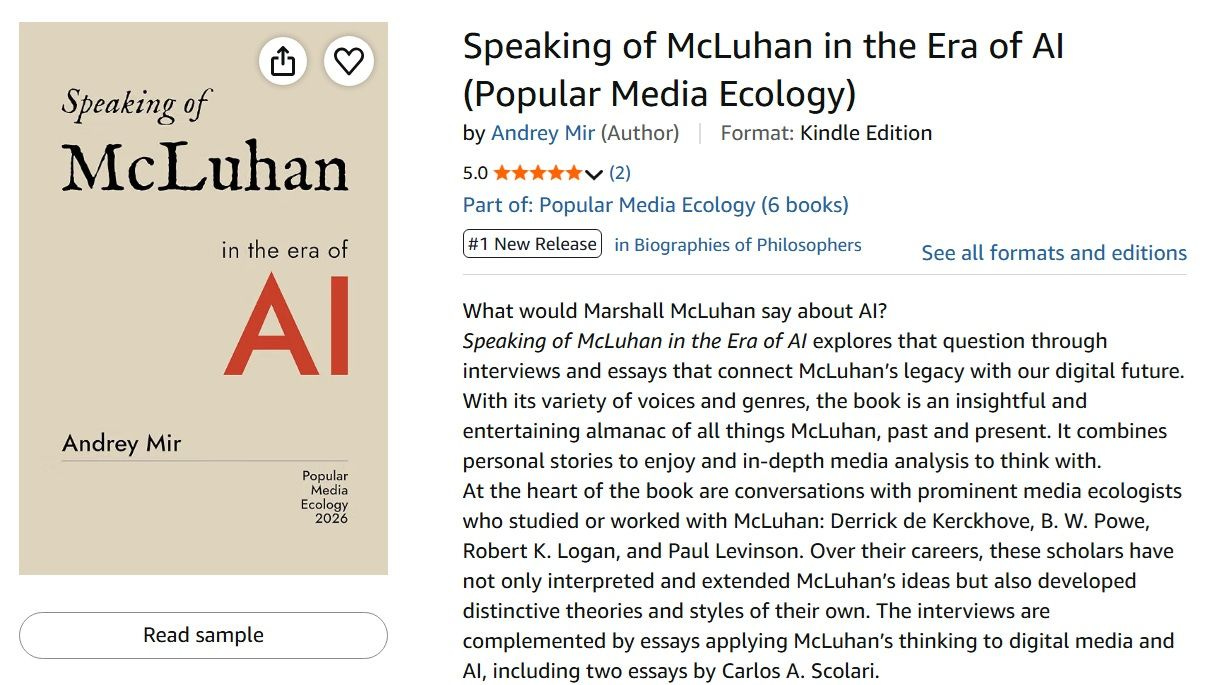
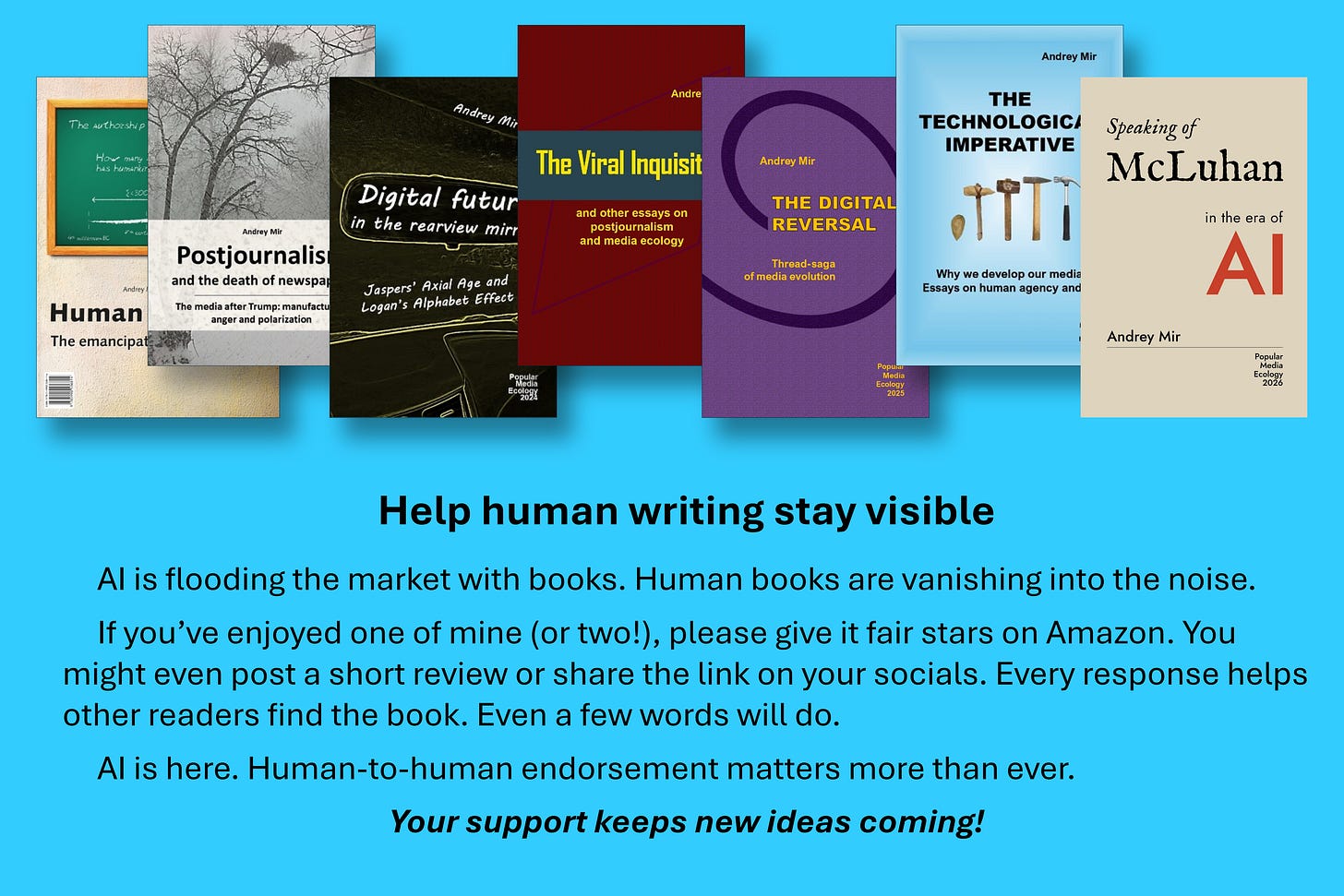
Is this already on your bookshelf? “Speaking of McLuhan in the Era of AI” is currently #1 New Release in Amazon’s Biographies of Philosophers after 18 days of sales. It’s not exactly a biography and not exactly of a philosopher, but ok.
See other books by Andrey Mir:
- NEW! Speaking of McLuhan in the Era of AI (2026)
- The Technological Imperative: Why We Develop Our Media. Essays on Human Agency and AI (2026)
- The Digital Reversal. Thread-Saga of Media Evolution (2025)
- The Viral Inquisitor and other essays on postjournalism and media ecology (2024)
- Digital Future in the Rearview Mirror: Jaspers’ Axial Age and Logan’s Alphabet Effect (2024)
- Postjournalism and the death of newspapers. The media after Trump: manufacturing anger and polarization (2020)
- Human as media. The emancipation of authorship (2014)

Categories: Future of journalism


Leave a Reply