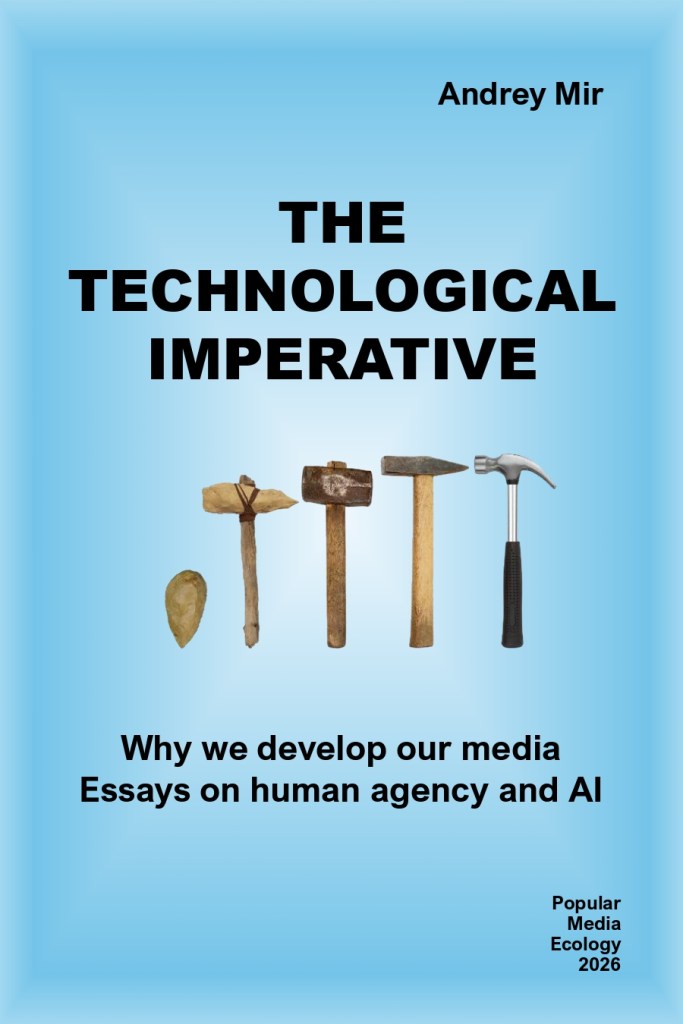
Do humans shape technology—or does technology shape us? This seemingly abstract question became crucial when humankind invented the atomic bomb: can we control the bomb? Now it has reemerged with AI. Are we served by AI, or do we serve AI?
This book introduces a powerful idea—the technological imperative: the inherent tendency of any medium to evolve toward greater performance and capability. Acting as the invisible hand of media evolution, it drives technologies toward their own ideal forms.
Consider the evolution of the hammer: from an ugly piece of rock to an elegant modern design. The individuals who invented its forms are beside the point—each simply used available resources to approximate the “ideal” form of the hammer as an extension of the hand. This was the technological imperative that drove the evolution of the hammer.
Now apply this to AI. AI is evolving toward its own “ideal” form at unprecedented speed. We humans are facilitating the process. But what is the “ideal” form of AI? Where is the technological imperative driving it? We can observe it in the hammer, but what can we expect from AI?
AI has already crossed the threshold from tool to environment, from instrument to autonomous cognitive process. It is no longer simply assisting human work—agentic AI is beginning to organize, optimize, and accelerate itself. Is “agentic” a prerequisite for “agency?”
At this pace, it becomes hard to see the bigger picture and address the bigger questions. In the meantime, some of those bigger questions have turned urgent and practical. For example, how do you prove you are human? Suddenly, sophisticated media theories become relevant and have to yield simple, practical answers: to prove you’re human, you need to show your ID, effort, or flaws.
This isn’t another AI book. The Technological Imperative places AI and other newest media into patterns of media evolution, a process driven by the technological imperative, a force that may ultimately outgrow humans. Stitching together eleven essays and one interview, the book offers a framework that is historically grounded, intellectually uncomfortable, and impossible to unsee.
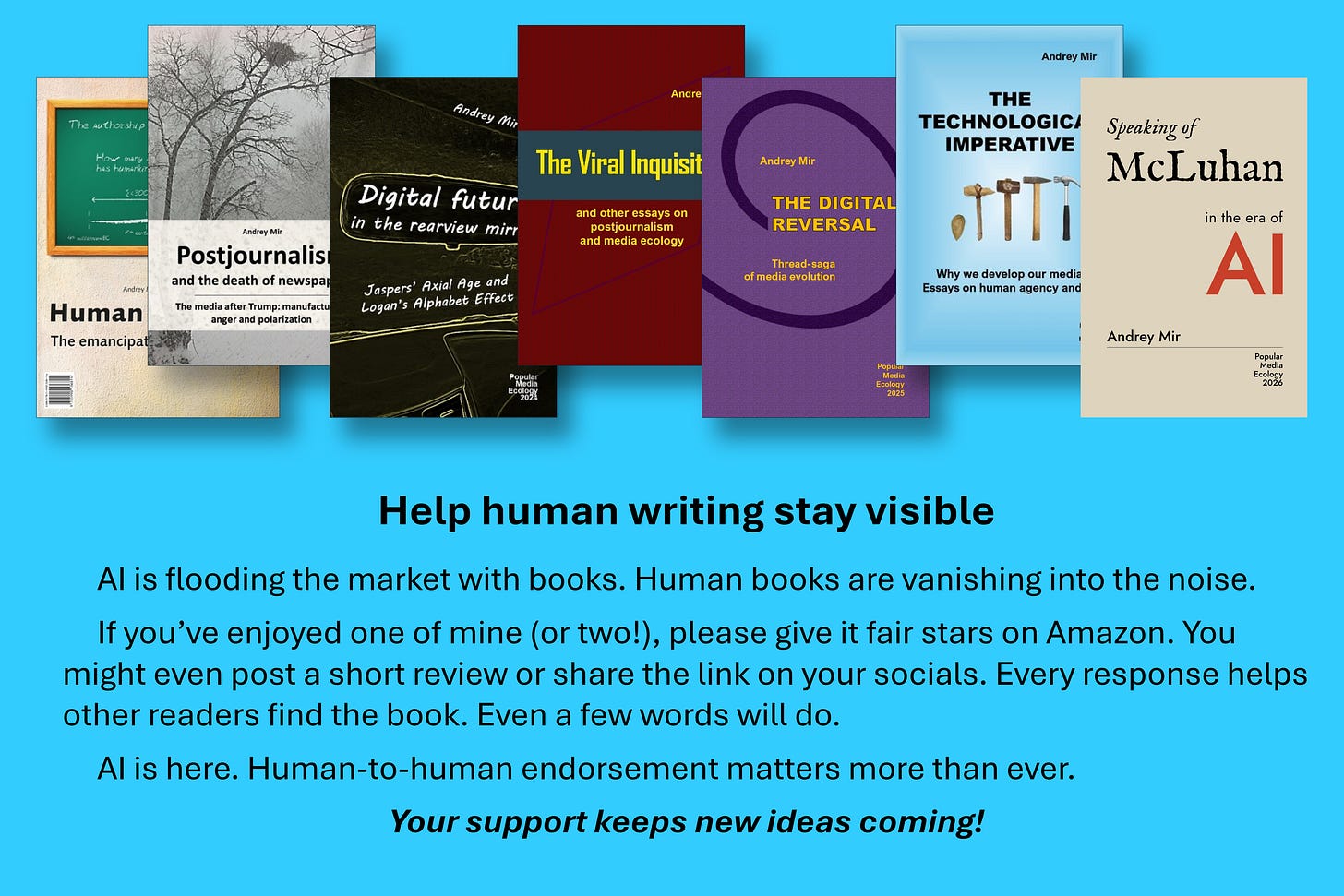
See other books by Andrey Mir:
- NEW! Speaking of McLuhan in the Era of AI (2026)
- The Technological Imperative: Why We Develop Our Media. Essays on Human Agency and AI (2026)
- The Digital Reversal. Thread-Saga of Media Evolution (2025)
- The Viral Inquisitor and other essays on postjournalism and media ecology (2024)
- Digital Future in the Rearview Mirror: Jaspers’ Axial Age and Logan’s Alphabet Effect (2024)
- Postjournalism and the death of newspapers. The media after Trump: manufacturing anger and polarization (2020)
- Human as media. The emancipation of authorship (2014)