What would Marshall McLuhan say about AI?
Hello media determinists,
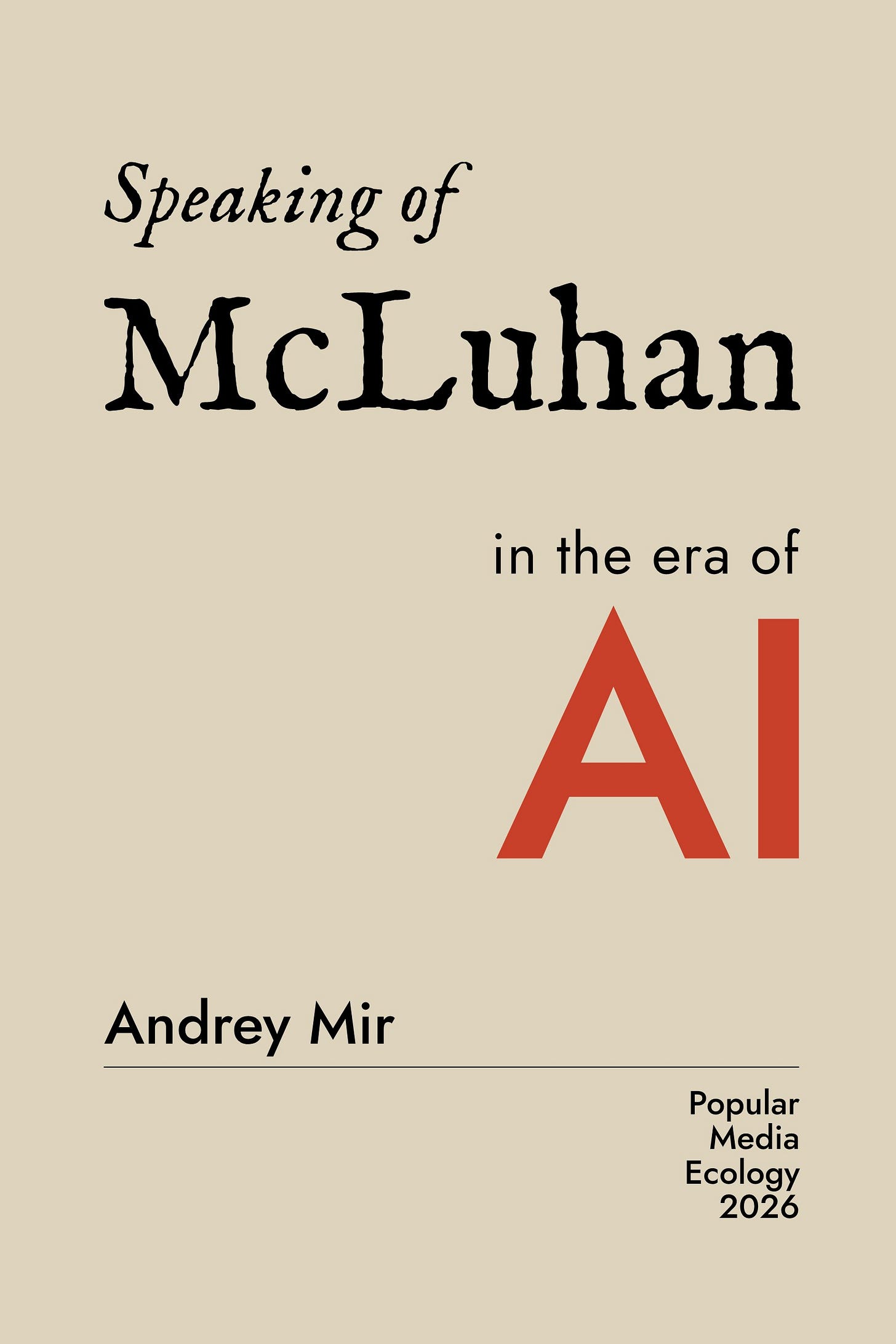
I’ve got spooky Halloween news: my new book, Speaking of McLuhan in the Era of AI, is out!
McLuhan has been called an intellectual trickster—but for many, his tricks with words and ideas were a treat. Not that I planned to release the book on Halloween, but McLuhan certainly wouldn’t have missed a chance to play with words and meanings—Halloween or not. So a Halloween release it is, with a treat about the trickster.
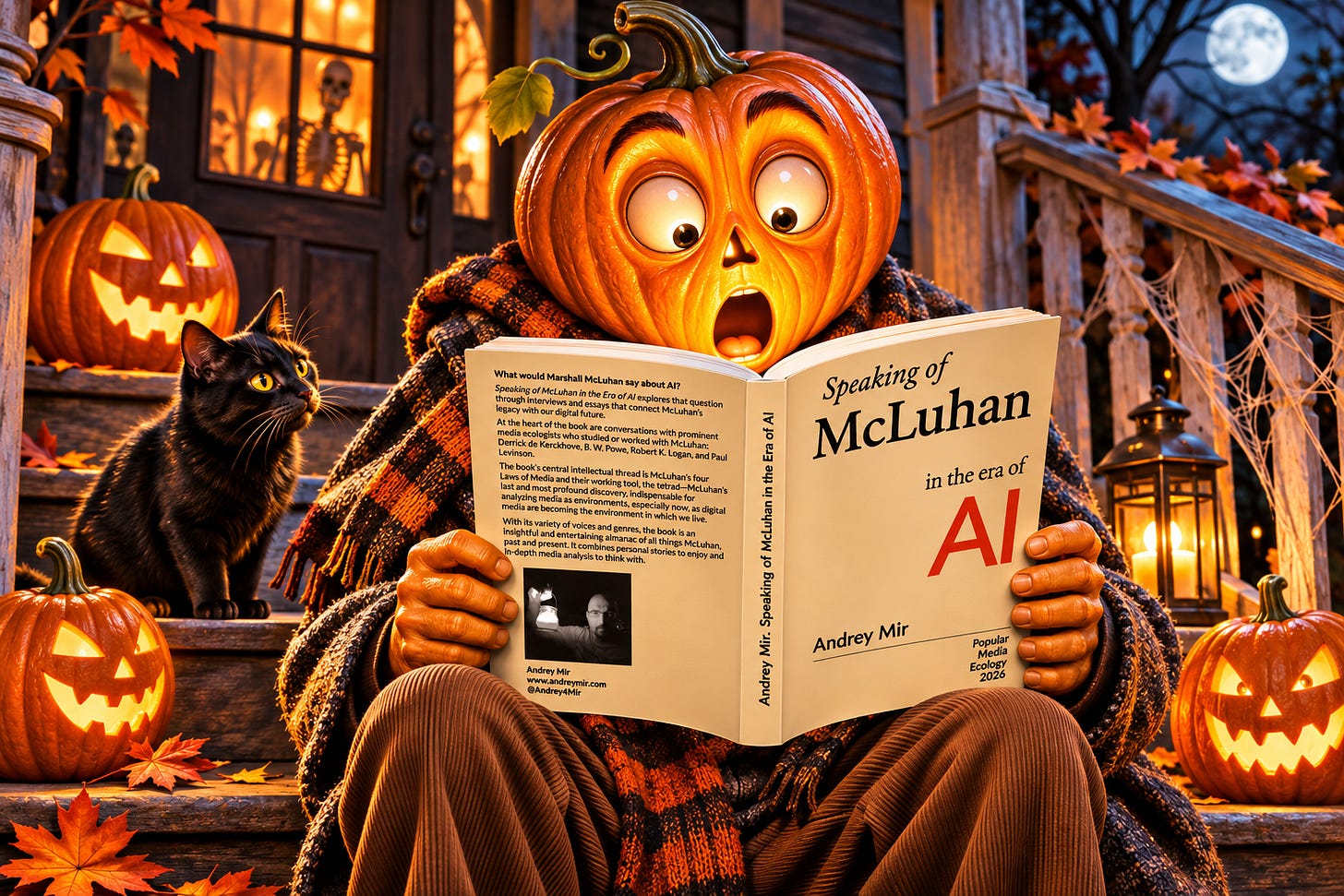
WHAT would Marshall McLuhan say about AI?
Speaking of McLuhan in the Era of AI explores that question through interviews and essays that connect McLuhan’s legacy with our digital future.
With its variety of voices and genres, the book is an insightful and entertaining almanac of all things McLuhan, past and present. It combines personal stories to enjoy and in-depth media analysis to think with.
At the heart of the book are conversations with prominent media ecologists who studied or worked with McLuhan: Derrick de Kerckhove, B. W. Powe, Robert K. Logan, and Paul Levinson. Over their careers, these scholars have not only interpreted and extended McLuhan’s ideas but also developed distinctive theories and styles of their own. The interviews are complemented by essays applying McLuhan’s thinking to digital media and AI, including two essays by Carlos A. Scolari.
Alongside firsthand accounts, lovely anecdotes, and applications of McLuhan’s insights, the almanac contains unique documents, including a previously unpublished letter from McLuhan to Levinson. The book also lists key McLuhanist organizations and resources and features many of the leading McLuhanists.
The book’s central intellectual thread is McLuhan’s four laws of media and their working tool, the tetrad—a foundational framework he developed with his son Eric.
McLuhan invented the laws toward the end of his life, after the peak of his fame had passed. That’s why his four laws—enhancement, obsolescence, retrieval, and reversal—never received popular acclaim on a par with “the medium is the message” or “media as human extensions.” Yet the laws of media became his most profound and, atypically for McLuhan, most systematic discovery, indispensable for analyzing media as environments, especially now, as digital media are becoming the environment in which we live.
Speaking of McLuhan brings together people who were close to McLuhan in his last years, when he was preoccupied with the laws of media and the tetrad. They and other leading McLuhanists discuss how the laws work and how to apply them, from past media to AI.
As an almanac of all things McLuhan and a guide to his laws of media, Speaking of McLuhan puts McLuhan’s thinking to work in today’s media reality. By the end of this book, you won’t just wonder what McLuhan would say about AI—you’ll know his thinking well enough to venture an answer.
Part I of this book, “Revisiting McLuhan,” opens with the essay “Why McLuhan Matters,” which outlines who he was and who he is, and gives several examples of applied McLuhan in the era of AI. It also includes a review of Tom Cooper’s Wisdom Weavers: The Lives and Thought of Harold Innis and Marshall McLuhan to set the historical scene for exploring McLuhan’s ideas.
Part II, “Speaking of McLuhan,” includes interviews with Derrick de Kerckhove, B. W. Powe, Robert K. Logan, and Paul Levinson, who share their memories of working with McLuhan and discuss his relevance today. Over their careers, these media ecologists have not only interpreted McLuhan’s ideas but also developed their own theories and styles—and I introduce them in short pieces after each interview. This part also includes a never-before-published letter from Marshall McLuhan to Paul Levinson about the tetrad, McLuhan’s last great invention.
Part III, “Following McLuhan,” contains two essays by Professor Carlos A. Scolari on the laws of media and reversal, and his interview with me, in which we debate the relevance of the law of reversal today. In the following essay, I break some of McLuhan’s rules and explain the significance of reversal in the digital era. Finally, Sam Kahn and I discuss why humankind cannot stop technology in an interview he conducted for The Republic of Letters.
In the appendix, the reader finds Extensions of the Man.
Extension 1 includes a catalogue of McLuhan’s reversals from Robert K. Logan’s 2021 book McLuhan in Reverse: His General Theory of Media (GToM).
Extension 2 includes the never-before-published program and abstracts from the 1978 McLuhan-Levinson Tetrad Conference.
Extension 3 presents a short catalogue of the essential McLuhan organizations and resources today.
The book concludes with a footnote that suddenly extended into a short historical detective story unravelling the mystery of the McLuhan Oar. I wish I could say the McLuhan Oar is essential for understanding AI… But I’m sure you won’t skip this charming McLuhan anecdote anyway.
Speaking of McLuhan in the Era of AI is available on Amazon in Kindle and paperback. Hardcover and audiobook are coming soon. Check it out, spread the word. Don’t forget to leave a rating—it helps increase the book’s discoverability.
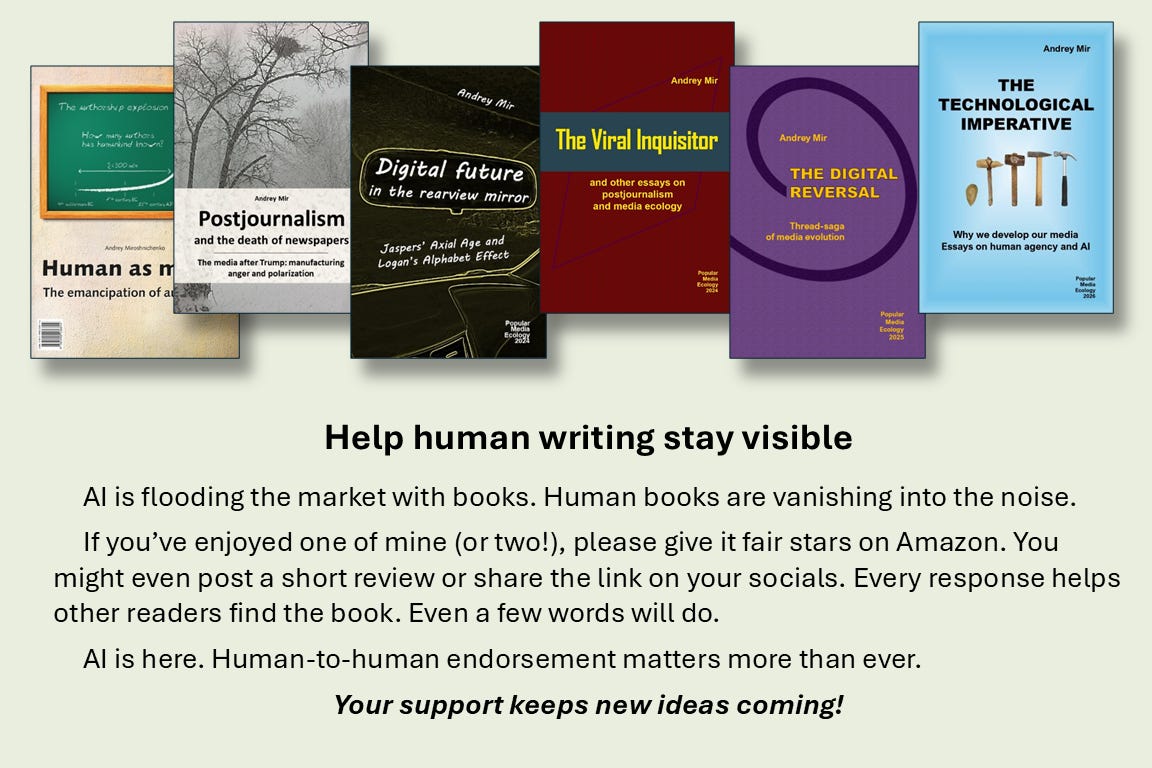
See other books by Andrey Mir:
- NEW! The Technological Imperative: Why We Develop Our Media. Essays on Human Agency and AI (2026)
- The Digital Reversal. Thread-Saga of Media Evolution (2025)
- The Viral Inquisitor and other essays on postjournalism and media ecology (2024)
- Digital Future in the Rearview Mirror: Jaspers’ Axial Age and Logan’s Alphabet Effect (2024)
- Postjournalism and the death of newspapers. The media after Trump: manufacturing anger and polarization (2020)
- Human as media. The emancipation of authorship (2014)

Categories: Marshall McLuhan, Media ecology, Polarization, Technological imperative


Leave a Reply