A review of Andrey Mir’s “The Digital Reversal.” By William Kuhns.
From the upcoming issue of New Explorations. Studies in Culture and Communication.
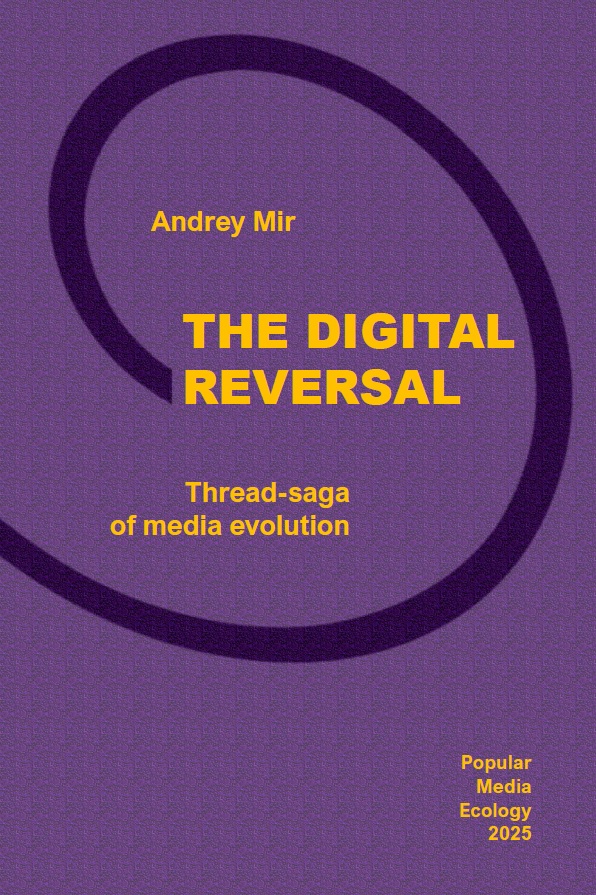
At first blush it sounds like a 21st century fairy tale: how at enough clicks of the “I like” thumb-ups icon, everything in sight is transformed into its precise opposite. It’s no fairy tale. It is the premise – and the electrifying achievement – of Andrey Mir’s audacious new book, The Digital Reversal: Thread-Saga of Media Evolution.
It has long been conspicuous that Andrey Mir is the most exciting writer today working the grand discovery of Innis and McLuhan: that for all our media do for us, they do far more to us. The Digital Reversal, which takes Mir and his readers into an unforeseen stratosphere of transformations, extends that premise with startling reaches of perception.
Andrey Mir – shortened from Miroshnichenko – spent two decades as a Moscow journalist before transplanting himself and his family to Toronto in the early 2010s. Once in Canada he took on PhD studies in communication at York University and turned from journalism to scholarship, determined to apply the thought of Marshall McLuhan afresh to the media-saturated world of our 21st century.
The first proof of his McLuhan-Mir-roring chops appeared in 2014 with Human As Media. The emancipation of authorship. It was a rather buoyant study of the early heady days of the blogosphere and social media. It celebrated the ability of bloggers to collectively assemble and validate news and notions by means of what Mir presciently dubbed “the Viral Editor.”
Postjournalism and the death of newspapers. The Media after Trump: Manufacturing Anger and Polarization (2020) set Mir on a harsher path, investigating the demise of classic journalism and the many failed efforts to resuscitate it. Regrettably, all that has survived of those efforts turns out to be “postjournalism” — another felicitous Mir coinage — in which the reporting of events becomes a task not of exploration and information, but exhortation and affirmation. It’s reportage that pivots from raw facts to provide assurance to one or another of ever more divided tribes. Mir’s Postjournalism has a stirring subtext; it can be read as a veteran reporter’s lament to the loss not only of his career but to the very opportunity of classic newspaper journalism in the future.
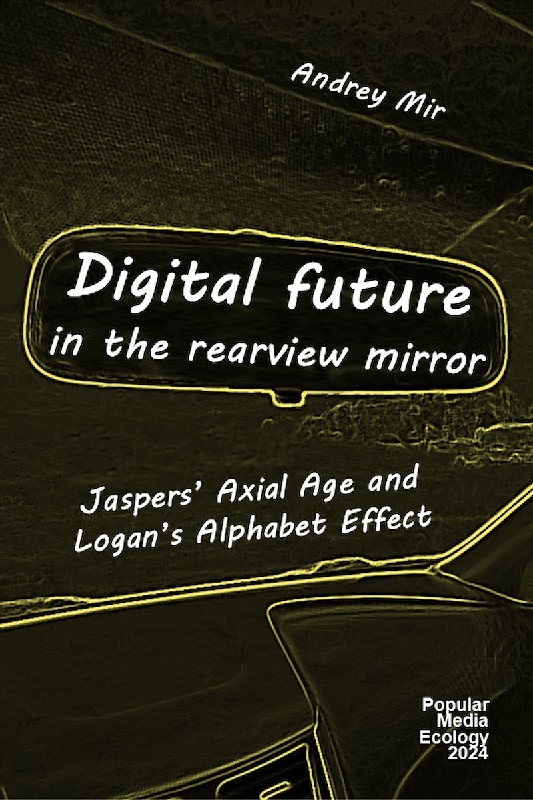
In 2024 Mir published Digital Future in the Rear View Mirror: Jasper’s Axial Age and Logan’s Alphabet Effect, an elaborate expansion on McLuhan’s observation that today we are undergoing the effects of literacy on tribalized people in reverse. From a wide-ranging, rigorously researched framework, Mir hones in on the wholly media-generated conflict of our time: between those grounded in print literacy and those who live entirely by digital orality.
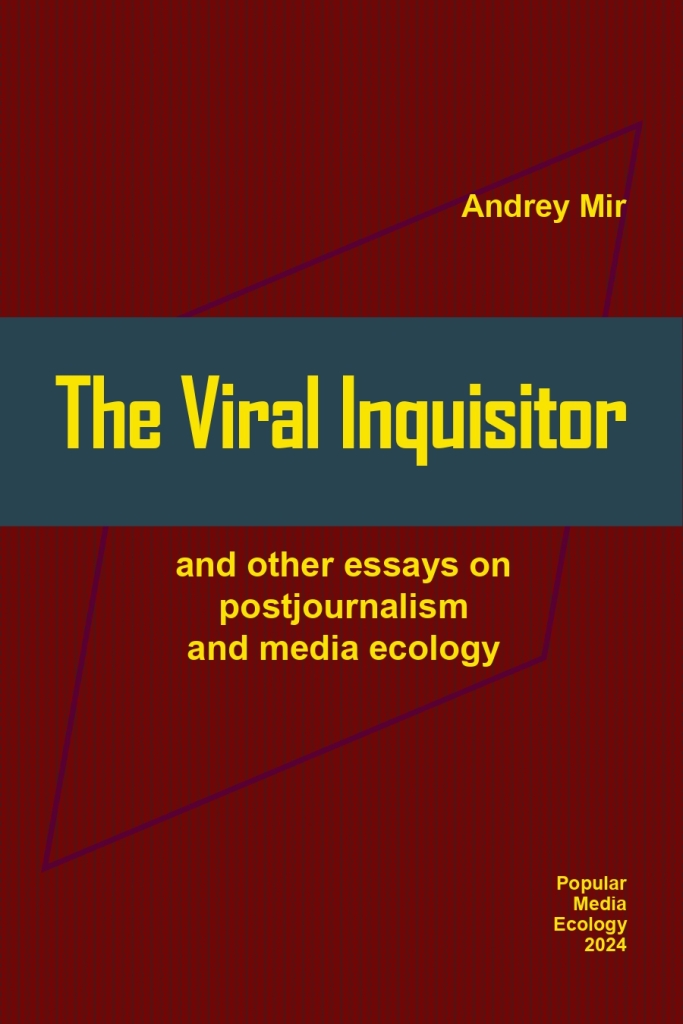
The Viral Inquisitor and Other Essays on Postjournalism and Media Ecology (2024) revisits the themes of Human as Media, accenting several reversals, most notably the reversal of the Viral Editor transformed into the censorious Viral Inquisitor.
Beginning with Postjournalism, Mir has been pursuing reversal as a theme: in the flip from journalism to postjournalism; in the ground-shifting reversal from literacy to retribalized orality; in the pressures driving the Viral Editor to become the Viral Inquisitor.
But who could have foreseen the magisterial expansions he would make of reversals in his newest work, The Digital Reversal: Thread-Saga of Media Evolution?
As he says late in the book:
Why do we live in a time of reversals? Because (1) any medium, when pushed to its extremes or limits, reverses its effects and (2) at the ultimate speed of interaction, everything is pushed to its limits. Everything – from biology to epistemology – ripens to reverse. (p 201)
In the Foreword, Mir describes the epiphany that gave birth to this book:
“Reversals, reversals everywhere!” occurred to me when I finished Digital Future in the Rearview Mirror. I explored how digital media reverse literacy and retrieve orality. Once that lens was designed, I looked through it and saw that digital media reverse everything else.
The abundance of signals reverses into noise. The abundance of facts reverses into fakes. Free access to self-expression on social media leads to abuse by trolls and bad actors and reverses into censorship. The revolt of the public reverses into anarcho-tyranny.
The abundance of choices flips into decision paralysis. The overload of news reverses into news fatigue and news avoidance. The collective mechanism of content selection – the Viral Editor – reverses into collective content policing: the Viral Inquisitor that watches you. (p 5)
It is one thing to say that we are living in a time of convulsive, exorbitant change. Many writers are saying that. It is quite another – and here is Mir’s distinction – to identify the precise trajectory of those changes as a wide-scale reversion of everything involving and invoking the digital, into its exact opposite.
This remarkable book has another distinction. It is written in sutras, compressed paragraphs kept under the 280-word count of a tweet. Mir playfully calls his book a “tweetise.”

In 2017 the Italian writer Robert Calasso announced that no one could give a name to our age. His book-length essay The Unnameable Present made a strong case that we live in a rudderless, unanchored, unfathomable and indefinable era. When Mir writes, “Reversals have become the Zeitgeist of the era,” (p 21), does he refute Calasso or subtly prove Calasso’s point?
As the first book I have encountered to focus wholly on reversals and its subtext of contraries, The Digital Reversal finds itself in illustrious company.
The Greek philosopher Heraclitus (540-480 B.C.E.) first announced a premise of reversals, the Law of Contraries, essential to an all-connected universe, in which opposites not only exist, but drive a greater unity through conflict and change. The “unity of opposites” Heraclitus described suggests that nothing can exist without the tension and tug of its opposite. A contemporary of Heracitus, living a few thousand miles to the east, the Chinese sage Lao Tzu (570-490 B.C.E.) in the Tao Te Ching, made a comparable claim for the yin yang principle of another subtext of reversals, complementarities: only by knowing hot can we know cold; only through high can there be a low. Thanks to Heraclitus and Lao Tzu, the Law of Contraries has one of the oldest pedigrees of any idea in all philosophy, Western or Eastern.
Toward the end of the18th century, William Blake defined contraries and their reversals as the engine of all progress and achievement:
Without contraries is no progression. Attraction and repulsion, reason and energy, love and hate, are necessary to human existence.
Blake kept diving back into that notion as his private sea, exploring contraries and their reversals in The Marriage of Heaven and Hell (1790) and later, Songs of Innocence (1789) then, five years later, its bitter, ironic rebuttal, Songs of Experience.
In Psychological Types (1921), Carl Gustav Jung borrowed from Heraclitus to coin the term enantiodromia, a compound of the Greek enantios (“opposite”) and dromos (“running”), literally meaning “running to the opposite” or “a running counter to” – a reversal of any extreme into its exact opposite. Jung used the term to describe “the emergence of the unconscious opposite in the course of time.”
The types of reversal identified by Mir are examples of enantiodromia, if not perhaps in the full Jungian sense.
Marshall McLuhan was enormously fond of reversals and made wheeling fun out of spotting and inventing new ones. In That Not-So Silent Sea, Edmund Carpenter’s 1993 memoir about his friendship with McLuhan, Carpenter describes how Marshall loved to flip famous lines and even laws of science into their opposites. “Affluence creates poverty,” McLuhan noted, one of numerous complementarities he coined; reputedly, his writing partner Barrington Nevitt kept a running sheet of them. McLuhan had even more fun quipping straight-faced reversals. Among his classics: “Poverty is the one thing money can’t buy.” “It is in the process of committing suicide that you find out whether you exist or not.” “In the land of the blind, the one-eyed man is a hunted criminal.”
McLuhan’s fascination with reversals would played a decisive role late in his career. In 1943, at 32, McLuhan completed his doctoral dissertation for Cambridge: The Place of Thomas Nashe in the Learning of His Time. Most of the dissertation tracked the historic rifts within the trivium, the curriculum for both ancients and medievals. The trivium was comprised of rhetoric, grammar and dialectic (logic). Most of McLuhan’s thesis charted the subtle war between those who propelled the growth of Western thought through analogy – the realm of rhetoric and grammar — and those whose engine was dialectic, or logic.
McLuhan – who according to Norman Mailer could “only think in metaphors” – clearly favored analogy, which sought bridges that asserted harmonies and unrecognized unities. McLuhan was congenitally suspicious of logic. He believed that when it went unopposed or untethered from analogy, logic spawned endless partitions, specializations, and conflicts. Throughout the 1970s, McLuhan attributed his disdain for logic as the problem of minds being misled by a disproportionate reliance on the left hemisphere of the brain. In a 1976 TV interview with Tomorrow host Tom Snyder, he said his critics fail to understand him because they are “left hemisphere people.”
McLuhan’s later career remained faithful to the findings of his dissertation. From the early 1950s to the mid-1970s, McLuhan focused on the rhetoric of media forms and all technologies: that is to say, the unexamined effects that these innovations have had on us all. In the mid 1970s McLuhan shifted his focus to investigate the grammar of all human utterances, discoveries and innovations – that is, of all media. McLuhan’s final major work, with his son Eric, was a universal grammar of media, titled Laws of Media, published eight years after McLuhan’s 1980 death. In Laws, McLuhan pere and fils identified four governing laws, which they dubbed the Tetrad. The Tetrad asked of every fresh form of human expression or extension:
- What does it amplify? (The law of Amplification)
- What does it obsolesce? (The Law of Obsolescence)
- What does it retrieve from an earlier era? (The Law of Retrieval)
- What, when pushed to an extreme of acceleration, overabundance, or overperformance, does it flip into as its opposite? (The Law of Reversal)
By the Law of Reversal, an overcrowded highway reverses into a parking lot. Money moving at electronic speeds flips into credit.
McLuhan’s notion of reversals from ultra-fast speeds and overabundance becomes the starting point for Andrey Mir’s The Digital Reversal. Mir argues that the high speeds and extreme overabundance of messaging in social media are pushing us all to breaking points that trigger profound reversals.
Mir has written an encyclopedia of reversals that I suspect, had he been alive for this era, McLuhan might himself have written. Mir is not just a gloriously attentive scholar. His decades as a journalist in Moscow supply The Digital Reversal with robust evidence gleaned from a stunning variety of sources, giving the book a depth of focus and an authoritative grounding in its time rarely found in any scholarly endeavor.
While Mir achieves an imaginative and perceptive audacity that echoes McLuhan, he writes in the attentive scholarly manner reminiscent of McLuhan’s foremost early discipline, Walter Ong. Like Ong, Mir seems to be balancing McLuhan’s lunging analogs with a finely parsed, logically assembled structure.
As I read, I kept scratching my head. How have we missed what Mir has found? I could not find much fault in Mir’s extraordinary perceptions. Only a growing marvel that he could find so many reversals, all of them in plain sight, waiting for a perceptive observer to announce them. By midway through the 246-page book, I bought into Mir’s claim early on, that “Reversals have become the Zeitgeist of the era.” (p 21)
But what is it about our age that makes it an age of so many reversals? I kept asking.
Mir answered me.
For the first time in history, human action in the outer environment is millions of times faster than the inner capacity of the human body to process signals. For the first time, the responsiveness of the media environment outpaces that of the human body itself. (p 201)
So, the speed of environmental interactions hasn’t just approached the limits of the human body – it has burst through those limits by a factor of millions. If approaching the limits is the condition of reversal, what is the outcome of crashing through the limits? […] No wonder reversals are everywhere. Just look at what something used to be, imagine its opposite, and you’ll have a fairly accurate forecast. (The only issue with accuracy may come from failing to see what the true opposite actually is.) (p 202)
That English is Mir’s second language scarcely shows in the writing. Or maybe it does: he frequently reminds me of other writers who tackled a new language or dialect in middle age: Joseph Conrad, Vladimir Nabakov, or my personal favorite, Raymond Chandler.
As ever, Mir’s gifts as a writer are here on full display. Not only are Mir’s startling perceptions of our world today surprisingly fresh; many of them meet the criterion proposed by Henry James: “perception at the pitch of passion”. And, as ever, Mir’s aphorisms often snap with concision and wit.
Just yesterday, journalists rigorously separated facts from opinions; today, many see themselves as counselors in a nation-wide re-education camp. (45)
Catalog assumes the world has a neat structure. Keyword search turns the world into a mess, a pile of garbage where you grab what you need. Prompt literacy destroys literacy. (p 106)
[In an oral society] Truth served tribal unity and survival, not cognition of the world. (p 113)
Monotheism trained people to accept only one, absolute truth. (p 114)
Crowdsourced truth: the reversal of truth into significance. (p 117)
Digital humankind is discarnate, but it also incarnates in AI. (p 148)
The growing use of dark mode [in smart phone screens] marks another sign of the Gutenberg era’s end. (p. 128) […] when light illuminates objects, it keeps the viewer more detached, allowing for analytic perception. When light itself carries information and “shines” on you, it favors immersion. That’s what screens do – they make the user dive into the flow of their content. (pages 129-130)
Promethean media [e.g., the first media given to people by Prometheus, such as fire and tools] were home builders; electronic and digital media are homewreckers. (p. 168)
Mir comes closer than anyone I have read to articulating a full-blown metaphysics of social media. That metaphysics is wide-ranging: it includes a social psychology, a neuro-physiology, an economics, and an epistemology. A few of his tantalizing passages:
[In social media] Truth is a referendum by likes. (p. 118)
The shift from structured reality to endless flow triggers anxiety, depression, and procrastination. Interestingly, the growing rate of ADHD might indeed reflect not only a detrimental side effect of electronic and now digital media, but also a form of adaptation. (p. 126)
Digital kids are not lazy or spoiled. They actually work hard – but they work for media evolution. The more time they spend online, the less they are attuned to physical reality. This is all a media effect, not a failure of character. That’s why parents’ media literacy is crucial. (p. 134)
Social media have inaugurated crowdsourced truths as a side effect of their design. (p. 118)
Formidably, in Digital Future in the Rear View Mirror, Andrey Mir proved himself to be a superb chronicler of our current transition into retribalization. The Digital Reversal offers even more formidable proof:
Why do social media retribalize society? Because, to commodify engagement, they encourage their users to display their impulsive reactions to each other. This retrieves the tribal condition of humans’ mutual impulsive exposure, atypical for literacy but typical for orality. (p. 60)
When the only medium for coordination and memorization is other people, the only way to succeed is by triggering their response, achieving rapport, and inciting their contribution to collective coherence. Most of the effort in oral speech is spent on tuning people in. (p. 87)
Abstract ideas, the cornerstone of rational reasoning and European civilization since Plato, are demoted in such conditions. The prioritization of personal feelings and lived experience affects all areas of life, from politics to education, from high art to mass culture. (p. 111)
I must give special credit to two Andrey Mir neologisms, fresh to me in reading The Digital Reversal.
First, he uses the term “platform capitalism” to describe how Facebook “owns” and “enslaves” the busy users of its exchanges. Accordingly, one of his reversal headers reads: “Platform effect: the reversal of convenience into slavery.”
I found “platform capitalism” a more compelling term than Shoshana Zuckoff’s “surveillance capitalism,” though both boil down to the same core companies and the same algorithmic paradigm.
Mir on Platform Capitalism:
“The platforms’ ability to control and modify user behavior invites political control. Web 5.0 [today’s emerging model] makes platforms operate not only as businesses but also as state proxies, employing their power over users on behalf of government in exchange for a license to operate.” (p. 103)
The other term? Mir did not invent it but he adapts it and employs it to fine effect: Affordance.
Webster’s defines affordance as “the quality or property of an object that defines its possible uses or makes clear how it can or should be used.”
Affordance provides an excellent example of how well Mir updates McLuhan with contemporary perceptions and language while maintaining and seldom shifting from McLuhan’s grounding. Affordance is the attraction bias implicit in any media form, as in: “The affordance for billions to submit their requests for affirmation is reshaping politics, culture and ethics.”
Mir, on affordances:
The principle of affordance is captured in the saying, ‘To a man with a hammer, everything is a nail.’ The opposite, ‘Guns don’t kill, people do,’ is wrong: guns are designed to pierce living flesh from a distance. This affordance – not just human intent – shapes outcomes.” (P. 23)
The microphone begat crooners, who sang softly and intimately… That was probably the only instance when an electronic medium ushered in intimacy – a byproduct of literacy. Otherwise, loud listening, enabled by the loudspeaker, created the affordance for overt self-display, as in oral-tribal settings. (P. 184)
Mir’s final chapter, “The Reversal of Humankind” has raised contentious voices in some quarters. Mir cites Paul Levinson’s 2017 Human Replay: a Theory of the Evolution of Media and makes an observation which has alarmed some readers.
To extend Levinson’s idea of human replay: digital media offered us a nearly perfect replay of the entire human persona in our image and after our likeness – but then reversed human replaying into human replacing, as media always do to the human organs or faculties they extend. (P. 212)

Replay becomes replace – admittedly, I found that suggestion somewhat pat and over-reaching but frankly, “pat and over-reaching” can rightly be said of many of the reversals Mir has assembled here. (It can be said as well of many of the assertions in McLuhan’s Understanding Media.) But “replay becomes replace” is of a piece with all that came before: Mir anticipating a reversal by applying the same perceptions and logic with which he tracked so many earlier reversals.
Marshall Soules has pointed out a remark by Henry Louis Gates, Jr. that helps clarify the “replay into replace” conundrum. Notably, improvisation – making changes on the fly – is “nothing but repetition and revision.” This observation can be applied to human evolution: if replay (repetition) leads to replacement, it suggests that, according to the science, evolution prefers revision over replacement.
The essential question Mir raises in the final chapter persists. Will our digital doppelgangers eventually produce the effect of translating us into versions of them, so that as they become ever more humanlike, we become more robotic? This was McLuhan’s fear. Early in 1964 he said to a news reporter, “The future work of mankind is to achieve relevance.”1

Recently, for my upcoming graphic novel of McLuhan’s life, I commissioned a cartoon, using as its caption, “The future work of mankind is to achieve relevance.” In this cartoon, men and women in business suits sit dismally on sidewalks, their faces glazed with the empty expression of the homeless and helpless. Walking briskly past them are bustling robots, many carrying attaché cases, on their way to and from their offices.
The final section of the final chapter of The Digital Reversal is “Anti-environmental counter-digital media literacy: a much-needed reversal” (p 226). It’s Mir’s plea for digital literacy education. In it, Mir writes:
Media have evolved from implements to environments – though it is rather our understanding that has evolved, Accordingly, the understanding of human agency needs to “evolve.” People can harness the instrumental use of a medium but not its environmental force. (P. 227)
Perhaps, now that Mir has covered so much territory in the progression of his books from Human as Media to The Digital Reversal, his next book might focus on digital literacy education. If so, his progression would continue to Mir-ror McLuhan; the last book McLuhan saw published in his lifetime – appearing two years before his devastating September, 1979 stroke – was the textbook, City as Classroom.
Looking back over Mir’s argument, I must admit to reservations.
One overall impression: are these reversals current or forthcoming – and if forthcoming, when? I think of that sparkling conversation on TV Ontario in 1968 between Marshall McLuhan and famed novelist Norman Mailer, when Mailer remarked ever so casually, “Well, I think you’re anticipating a century perhaps.” With many of his reversals, Mir certainly anticipates. But in our speedups of absolutely everything – by a century?
And must – must, must — this onslaught of reversals be so relentlessly dystopian as Mir makes them out to be? McLuhan’s pet example of a reversal caused by computers was a return to cottage-industry, do-it-yourself crafts. And isn’t one of the reversals caused by our disembodying “translation into information processes” already apparent as a freshly awakened attention to bodily vigor: in gym workouts, jogging, pilates, and yoga?
Another quibble: Mir’s examples of the drivers of these reversals are almost always social media. Have social media become the decisive communication medium of our age, or do social media share that role with the internet more broadly, and other electronic media, such as television?
I found one Mir passage with which I take particular issue, primarily because McLuhan countered its assertion soundly. Mir’s passage:
The media-driven focus on identity is here to stay; no one can reverse the reversal and return society to the supposedly healthier factory settings of literacy – because the focus on identity is the factory setting of the current media hardware of society. (P. 79)
So long as our current profit-driven trajectory proves the inalienable driver of technologies and their uses, Mir’s analysis will no doubt remain accurate. But as a species humanity is in its adolescence of becoming morally and spiritually fit and responsible for its technologies. Will the profit motive always and forever determine how technologies evolve and are applied? I have found two instances in which McLuhan countered Mir’s passage. One is from 1960, the other, the more forceful, from 1966:
“There are means of sustaining civilization by the very same media which have dissolved the older media and technologies.” (1960 – The NAEB Report on Understanding New Media, p. 8)
“You can now program an environment so as to create the effects of literacy without ever having taught people how to read or write.” (1966 – Diebold Dialogue: Marshall McLuhan and Mike Wallace, published transcript, p. 20)
Another quibble I must admit to: is digital orality the best description of our movement into what may yet prove to be a post-lingual era? I believe – and I believe McLuhan believed – that our electronic age will retreat not only from the written word but from spoken and written language altogether. Perhaps “digital orality” is merely an early stage in the evolution of new portals of communication evoked by McLuhan when he startled Playboy interviewer Eric Norden in 1969:
If you have difficulty envisioning something as trivial as the imminent end of elections, you’ll be totally unprepared to cope with the prospect of the forthcoming demise of spoken language and its replacement by a global consciousness. (Essential McLuhan, 1995, p. 252.)
Mir anticipates an upcoming bridgework between human brains and A.I. equipped computers in the not-distant future. Would not this union – promoted by Ray Kurzweil as the forthcoming “Singularity” – provide the infrastructure of an internet not of shared data, but of shared minds?
These are my primary reservations about an otherwise arresting and important book on the nature of the changes we are all undergoing in our time of speed-of-light accelerations. A final “Huzzah!” to Andrey Mir for bringing McLuhan, live and kicking, into the decade of all-surrounding reversals. I greatly admire Mir‘s originality, his vigorous perceptions, and his livewire writing. Andrey Mir teaches at York University but he strikes me as more than a teacher. He has proved himself an avid learner, of a sort that brings to mind Eric Hoeffer’s tribute to learners in times of convulsive transition like our own:
“In times of great change, learners inherit the earth, while the learned find themselves beautifully equipped to deal with a world that no longer exists.”
From the upcoming issue of New Explorations. Studies in Culture and Communication.
William Kuhns is co-author of The Book of Probes (2003), a collection of McLuhan’s probes (collaborating with Eric McLuhan, David Carson, and Mo Cohen).
See also books by Andrey Mir:
- The Digital Reversal. Thread-saga of Media Evolution. (2025)
- The Viral Inquisitor and other essays on postjournalism and media ecology (2024)
- Digital Future in the Rearview Mirror: Jaspers’ Axial Age and Logan’s Alphabet Effect (2024)
- Postjournalism and the death of newspapers. The media after Trump: manufacturing anger and polarization (2020)
- Human as media. The emancipation of authorship (2014)

Categories: Digital Reversal, Emancipation of Authorship, Future and Futurology, Marshall McLuhan, Media ecology, Polarization, Singularity and Transhumanism, Viral Editor, Viral Inquisitor
 Human as Media
Leave a comment