Alphabetic writing visualized not the objects or the ideas of objects but speech itself. Viewing recorded speech meant seeing the “footprints” of thinking. A chapter from Digital Future in the Rearview Mirror: Jaspers’ Axial Age and Logan’s Alphabet Effect.

The awakening of thinking about thinking that happened to the human mind about 2500 years ago is somewhat similar to a hypothetical self-awakening of AI, a much-discussed topic in 2024. The mind recognized itself and started exploring its own mechanisms and principles beyond the mundane tasks of practical applications. The awakening of the mind’s self-reflection was the main characteristic of the Axial Age, as described by Jaspers.
“Oral Greek did not know what an object of thought was,” writes Havelock.[1] For a thought to be caught, the flow of words needed be arrested and words needed be captured and separated from a thinking individual. Writing made it – it put captured words in front of an individual for contemplation. Looking at a sign entailed thinking of what this sign means and why.
The necessity to consider the relations between signs and objects became even more apparent in the scribal schools. Pondering the meanings of signs in the process of writing or reading could occur by chance—it was not necessarily a deliberate process. However, when teaching someone else to write, contemplating the meanings of signs became unavoidable.
Alphabetic writing visualized not the objects or the ideas of objects but speech itself. Viewing recorded speech meant seeing the “footprints” of thinking. When observing a string of written words, a reader sees a sequence of recorded thoughts. Thus, recorded speech exposed thinking to a detached observation. McLuhan called the alphabet the “means of arrested visual analysis.”[2] Writing separated the known from the knower, but the alphabet afforded further fragmentation – the separation of knowing from the known.
Since the Greeks were particularly affected among other Axial cultures by the abrupt transition from the sensory experience of primary orality directly to the most abstract level of alphabetic literacy, it didn’t take them long to objectify not only knowledge but also thinking itself.

Havelock highlights that, “Along with the discovery of the soul, Greece in Plato’s day and just before Plato had to discover something else – the activity of sheer thinking.” He emphasizes that “the same sources which testify to a sort of virtuosity in the use of the words for ‘soul’ and ‘self’ testify also to the same kind of virtuosity in the words for ‘thinking’ and ‘thought’.” According to Havelock, something novel was in the air at the end of the 5th century BCE, and this novelty was the “discovery of intellection.”[3]
The discovery of thinking about thinking and its relation to literacy is best exemplified through the succession of the philosophical method from Socrates through Plato to Aristotle.
Socrates (circa 470–399 BCE) was still an oral thinker. He knew writing and rejected it because written words were dead thoughts whereas speaking represented live thinking itself[4]. But he was already affected by the alphabet. This could be seen in his philosophical and pedagogical method of dialectics – the exploration of thinking by questioning the essence of what was said. Such questioning was unthinkable in an oral culture – the listeners were supposed to memorize, recite, and pass on what they heard, not question it. Socratic dialectics represented a cultural and pedagogical revolution, a blasphemy against the foundations of the oral society. This resulted in the death penalty for Socrates himself on the charge of “impiety” by the citizens of Athens.
Plato (circa 428–347 BCE), Socrates’ student, transitioned to writing, but most of his legacy consists of the recordings of presumably oral conversations. This is evident even in the genre of his writings, the dialogues. In these dialogues, he also recorded much of the Socratic legacy, often mixed with his own observations. It is symptomatic that, after transferring thinking from oral to written forms, Plato fiercely attacked the old Homeric mind shaped by poetry, or the oral state of mind, as interpreted by Eric Havelock in Preface to Plato.
Aristotle (circa 384–322 BCE), a student of Plato, was perhaps the first philosopher of literacy. He wrote not only dialogues but also moved to philosophical prose and wrote in the genre of the treatise, which has remained the main genre of philosophy since then. (As Logan notes, “With the alphabet a new style of writing developed – namely, prose – with which it is possible to create analytic statements. Abstract science without prose and analytic statements would be impossible.”[5]) Aristotle established the foundation of literate philosophy in many areas, from politics to poetics.
Other great Greeks, of course, had their share of merits in shaping Greek, Western and world philosophy during the transition from orality to literacy. However, these three, as it were, impersonated the transition of thinking from orality to alphabetic literacy in a clearly sequential manner and in an incredibly compressed historical period (compared to the overall very slow pace of history in ancient times). During the combined lifespan of this trio, the axis of the Axial Age occurred in Greece.
Instead of being satisfied with magical formulas and explanation through analogies, the philosophers started digging into the essence of things and eventually revealed that thinking itself is a tool. Enquiry about the world logically led to an enquiry about enquiry, i.e., about thinking. In his 1951 Bias of Communication, Innis suggests the media direct our focus of attention. He expressed this idea with the question: “Why do we attend to the things to which we attend?”[6] This is the ultimate Socratic question, indeed. According to Innis, media are the answer.
According to Marshall McLuhan, “Lineal, alphabetic inditing made possible the sudden invention of ‘grammars’ of thought and science by the Greeks.”[7] This grammar of thought and science manifested in two interconnected but separated intellectual faculties – theorizing and logical thinking. Theorizing and logical thinking were not just characteristics of some other intellectual activities – they were intellectual activities that recognized, reflected upon, and cultivated their own nature, in the same way as the grammar of language became the subject of grammar as a discipline.
Havelock highlights that Aristotle tied his definition of thinking to the metaphors of vision:
The words he chooses to describe their intellectual enterprise are theoria and its verb theorein, both referring to the act of looking at something. The choice may be a better pointer toward the real truth of what had happened. Why choose vision as the metaphor for an intellectual operation, unless guided by the subconscious recognition that the operation had arisen out of viewing the written word rather than just hearing it spoken?[8]
The “means of arrested visual analysis,”[9] as McLuhan called the alphabet, allowed one to see – with the eye – thoughts captured by writing. The isolated sense of vision created inner vision, and inner vision created an affordance of intellection. But theorizing became more than this. It started dictating its own rules, its “grammar,” demanding the creation of theories – complete and logically organized explanations of the world based on some universal principles. Theorizing completed the transition from perception to conception and the transformation of thinking from an oral to literate state.

Theorizing replaced rhapsodizing or “stitching songs together.” The deritualization of mind was a side effect. But for a theory itself to be stitched, a new tool of intellection had to be devised – abstract logic. Logic had nothing to do with sensorial experience. If magical (oral) thinking matched the supernatural with natural phenomena, logical (literate) thinking matched ideas with one another. In the oral tradition, moving forces were personified in gods within narratives intended to affect perception for better memorization. When the burden of memorization was taken from humans by writing, these were no longer gods that represented the moving forces of the universe but ideas that engaged in their own intricate interplay. As Havelock puts it, “These are not men and women but rather words and thoughts which cluster in competing formations and manoeuvre to challenge us and win our attention while they seek to elbow each other off the boards.”[10]
Instead of seeking analogies in past experiences or the natural environment, logical thinking employed its own “natural” analogy: it adopted the linearity and sequential unfolding of meanings from alphabetical writing. As Logan puts it:
The use of the alphabet serves as a model for matching – an activity crucial for the development of logic. Each letter of the alphabet is matched with a sound and vice versa. Every time a word is read, a match between a visual sign and a spoken sound is made. Matching forms the basis of rationality or logic. Rationality grew out of the concept of ratios, which in turn involves matching. A is to B as C is to D is an example of a ratio achieved by matching.
The linking together of the elements of the alphabet – the letters – to form words provided a model for the linking together of ideas to form a logical argument. Arguments are linked together in order to reach a conclusion. The deductive reasoning implicit in formal logic and geometry also formed the basis of early Greek science, which attempted to derive its description of nature from first principles.[11]
Theorizing and logical thinking represented a completely opposite approach to forming and expressing knowledge as compared to orality. To ensure better affect and therefore memorizing, oral knowledge required excessive means of expression, redundancy of epithets, numerous repetitions of important formulas, verbomotor activities (rhyme, tone, mimicry, gestures), and emotional engagement. This all would be a failure in logical reasoning. Logical thinking excludes repetition as a fallacy. Epithets are needless. Brevity and clarity are virtues in logic and in literate expression in general.
The capacity of literacy to facilitate theorizing relies, in no small part, on the “atemporality” of reading, as Corey Anton calls it. According to him, “books allow one to read at one’s own pace.” The content of reading is “seamlessly worked into the flow of consciousness” because “the text does not ‘go on’ without us.”[12] Anton suggests distinguishing between self-paced technologies, such as books, and auto-paced technologies, such as podcasts, films, and videos. He writes:
Communication technologies that run at a pre-set rate, which flow as it were and thereby demand that consciousness attend to them as they are flowing, are more psychically constraining and confining than self-paced technologies.[13]
The temporal constraints imposed by electronic formats that simulate orality immerse the user in an external environment, controlled by the source of broadcasting. Anton even implies that this submission to auto-paced technologies can explain the frustration often accompanying the consumption of electronic and digital media:
Could it be that there is an undiagnosed stress – an oppression of the mind – that comes from having to spend time within simulated environments that unfold at a rate not endemic to one’s own consciousness? Could it be that people have unconsciously trained their minds to obediently align to of auto-paced technologies and now experience a vague but pervasive sense of moving to other people’s rhythms instead of their own?[14]
Reading, on the contrary, adjusts the pace of information intake to the reader’s personal thinking rather than to someone else’s broadcast, thus integrating the content of what is read “seamlessly” into the inner space of the reader’s thought. Among all media, only books possess this quality, as Anton highlights. Reading is morphologically compatible with thinking.

Not only did literacy enable theorizing, but it also facilitated the accumulation of theoretical knowledge through the phenomenon of quotability embedded in reading and writing. Scholars would read what their predecessors wrote, pick up worthy quotes, and reassemble them in new theories while adding new ideas. The next generations would do the same, thus constantly refining and developing the best ideas in the chain reaction of theorizing, as it were. Each scholarly reading entailed writing.
Electronic media cannot do that. The content of TV or radio programs might be astonishingly intelligent, but it will unlikely be reworked in a new TV or radio program through quoting and adding ideas. This content may trigger some thoughts, but it is not quotable, as one cannot capture a worthy thought from TV and embed it in their own reflection to make it available for the next iterations of quoting and adding ideas. On TV, radio, and podcasts, any idea dies in the moment of broadcasting, resulting, at best, in viewers’ affection for the speaker. Likeability beats quotability. Electronic media refine and accumulate attitudes, not knowledge.
The internet made the world repository of texts available for quoting and adding upon. But the issue is that, unlike print literacy, digital orality fosters quick exchange, not prolonged reading and reflection. Books made bookworms, but digital consumption favours switching between sources while shortening the span of concentration. Digital media users quote memes, not thoughts. Memes are funny and sometimes witty, but they do not coalesce into theories. In the digital environment, the scholarly effort of reading and then quoting and adding ideas in subsequent writing may be maintained by personal willpower but is clearly disfavoured environmentally.
A chapter from Digital Future in the Rearview Mirror: Jaspers’ Axial Age and Logan’s Alphabet Effect.
See also books by Andrey Mir:
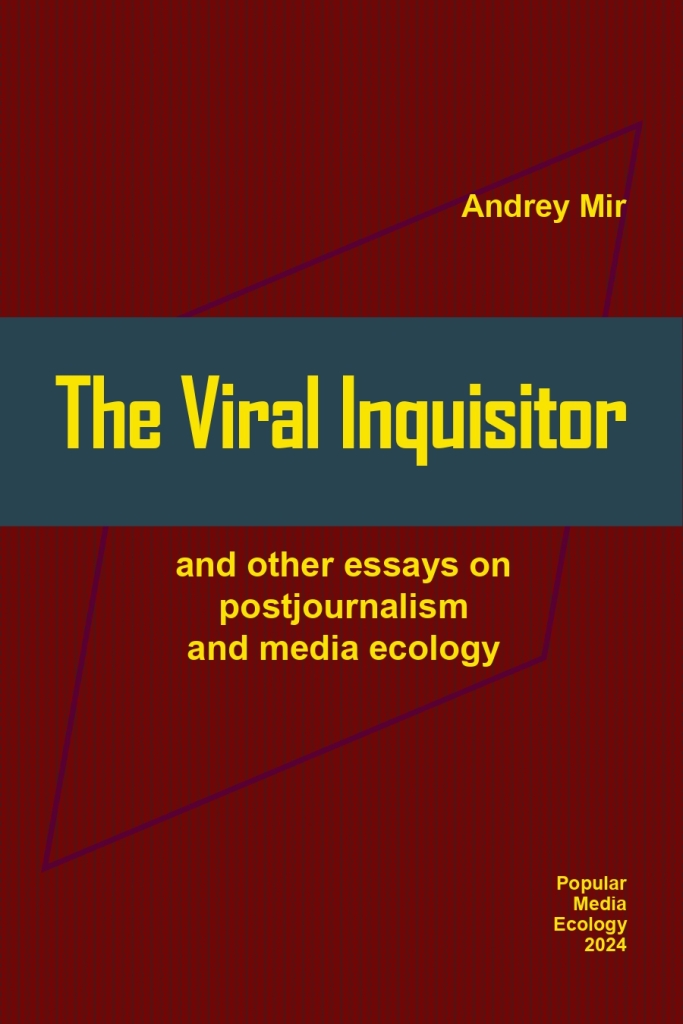
- The Viral Inquisitor and other essays on postjournalism and media ecology (2024)
- Digital Future in the Rearview Mirror: Jaspers’ Axial Age and Logan’s Alphabet Effect (2024)
- Postjournalism and the death of newspapers. The media after Trump: manufacturing anger and polarization (2020)
- Human as media. The emancipation of authorship (2014)

[1] Havelock, Eric. (1986). The Muse Learns to Write, p. 97.
[2] McLuhan, Marshall. (1962). The Gutenberg Galaxy, p. 23.
[3] Havelock, Eric. (1963). Preface to Plato, p. 200-201.
[4] In Plato’s Phaedrus, Socrates affirms Phaedrus’ assumption that spoken words are “the living word of knowledge which has a soul, and of which written word is properly no more than an image.”
[5] Logan, Robert. (2004 [1986]). The Alphabet Effect, p. 117.
[6] Innis, Harold. (2008 [1951]). Bias of Communication, kl 608.
[7] McLuhan, Marshall. (1962). The Gutenberg Galaxy, p. 23.
[8] Havelock, Eric. (1986). The Muse Learns to Write, p. 111.
[9] McLuhan, Marshall. (1962). The Gutenberg Galaxy, p. 23.
[10] Havelock, Eric. (1963). Preface to Plato, p. 276.
[11] Logan, Robert. (2004 [1986]). The Alphabet Effect, p. 113.
[12] Anton, Corey. (2023). “Reading good books, further defended,” p. 122.
[13] Anton, Corey. (2023). “Reading good books, further defended,” p. 122.
[14] Anton, Corey. (2023). “Reading good books, further defended,” p. 122.
Categories: Digital Future in the Rearview Mirror, Digital orality, Immersive experience, Marshall McLuhan, Media ecology
 Human as Media
Leave a comment