The Viral Inquisitor and other essays on postjournalism and media ecology by Andrey Mir (2024) has just been published. Buy it on Amazon.

Andrey Mir is the most profound observer of media, traditional and digital, writing today. No one else comes close. Mir is our present-day version of Marshall McLuhan – whose disciple, not coincidentally, he is – only without McLuhan’s self-importance and opacity. Mir writes in Toronto, Canada, McLuhan’s city. From there, he has delivered an astonishing series of books and articles that have changed our understanding of how the structures of communication have influenced history – and how they will shape the future.
Humans are word-obsessed animals. We closely scrutinize media content: Is it true or false? Good or evil? From a famous author or a mere unknown? Yet the truly powerful effects are produced by media structure, the form a medium imposes on communication. The structure of information is the environment, the landscape, on which not only our intellectual lives but our social relations evolve. Mass communication facilitated a society based on top-down control, for example, while the internet – Mir calls it “the emancipation of authorship” – has famously disrupted hierarchical arrangements. This, of course, is what McLuhan meant by his enigmatic formula, “The medium is the message.”
Mir is the foremost practitioner today of the environmental approach to understanding media. Which is another way of saying: he thinks big. In the essays collected for this book, the reader will encounter a set of capacious and highly original concepts that will serve as guide through the twisting labyrinth of modern media.
Let me offer a small sample.
A viral editor, Mir observes, governs accuracy on the web. Complaining about the huge volume of online lies is a commonplace ritual these days – but we only know these lies exist because they have been exposed as such by the web itself. (The viral editor belonged to the early phase of the digital era. In our politically turbulent present, the unmasking of falsehood has been undertaken by a viral inquisitor.)
Postjournalism is what happened to newspapers after their 20th-century business model, based on advertisement, collapsed. One may think that the New York Times has become heavily biased on behalf of progressive politics, but that’s only superficially true. The Times has effectively commoditized political polarization as its new business model. To make up for lost advertisement, it now makes a profit by becoming a sheltered garden for readers of a particular persuasion.
The historical transition from oral to textual communication was accompanied by tremendous psychological changes: for example, memory was no longer of supreme importance and emotive poetic language made less sense than logical prose. Mir maintains that the prevalence of the web has inaugurated an era of digital orality, “a new hybrid state of mind” that will alter the way we perceive the world – for example, by changing the parameters of shared truth. (“Two plus two is doubted if said by Hitler,” Mir notes, only half in jest.)
Everything Mir writes is original, his prose sparkles with aphorisms. His ideas, as I said, are immense and counterintuitive, but they are persuasive and easily understood. His knowledge of the history of media is astounding – I know a bit about this subject, and I invariably learn from him. His fearless speculation on a future driven by artificial intelligence is mind-expanding and resembles the best of science fiction.
We need explainers of Mir’s scope and breadth of vision. Contemporary humanity is a child lost in the woods, haunted by riddles at every turn. How did we get here? Where are we headed? Amid the affluence and luxury, given global communication and cheap travel to iconic places, what is the right path for us as individuals and as a people – and why? Yet authors today spew endless amounts of content, textual and visual, on frivolous subjects – celebrity, identity, the latest uproar surrounding Donald Trump.
Mir transcends the fractured triviality of our day and stands in closer alignment with the towering sages of the last century. He should be compared to Oswald Spengler, José Ortega y Gasset, Arnold Toynbee, no less than to McLuhan – thinkers who framed the human story in the widest possible context, thereby enlarging our understanding of the present and casting a flickering light into possible futures. Those writers may have been right or wrong, but they painted on a huge canvas and invited us to think of ourselves on a similar scale.
So it is with Andrey Mir. The ideas you are about to discover in the essays that follow are adventurous and imaginative – and, if I may say so, they redeem our age.
Martin Gurri
Buy The Viral Inquisitor on Amazon
See also books by Andrey Mir:
- Digital Future in the Rearview Mirror: Jaspers’ Axial Age and Logan’s Alphabet Effect (2024)
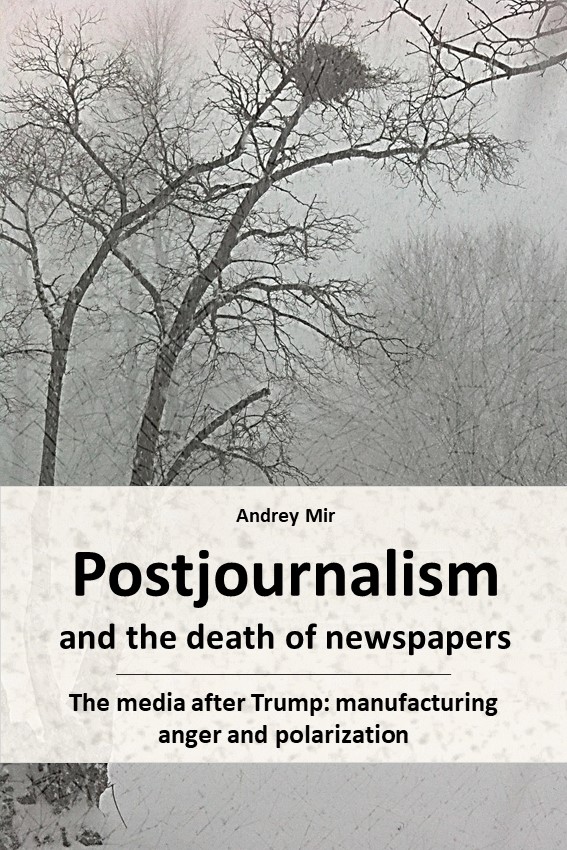
- Postjournalism and the death of newspapers. The media after Trump: manufacturing anger and polarization (2020)
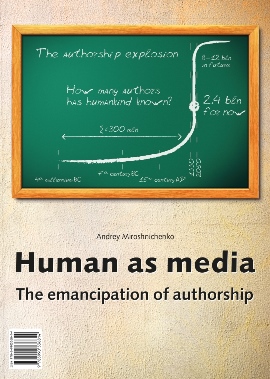
- Human as media. The emancipation of authorship (2014)

Categories: Digital orality, Emancipation of Authorship, Future and Futurology, Future of journalism, Immersive experience, Marshall McLuhan, Media ecology, Media literacy, Polarization, Singularity and Transhumanism, Viral Editor, Viral Inquisitor
 Human as Media
“We need explainers of Mir’s scope and breadth of vision… what is the right path for us as individuals and as a people – and why? Yet authors today spew endless amounts of content, textual and visual, on frivolous subjects – celebrity, identity, the latest uproar surrounding Donald Trump.”
The scope of the subject is so massive, this is exactly why I have searched for an heir to Mc Luhan and feel that I, too, have found it in Andrey Mir. As a humble artist who is not an intellectual, I am grateful to Mir for providing me with clues to try and best approximate the right path, knowing that my efforts will only have worth and effect in my own conscience. The future, indeed the present. is hard to imagine. A pandemonium of unimagined – and unimaginable – proportions. Cataclysmic, no doubt, but this time humanity will probably not come out alive. Frivolity, in such circumstances, strikes me as insanity. Given the pervasiveness of media, the field of media ecology should occupy the forefront of all serious reflection.