Hot off the press, a new book:
Digital Future in the Rearview Mirror. Jaspers’ Axial Age and Logan’s Alphabet Effect, by Andrey Mir (2024), buy on Amazon.
“A major theme of Digital Future in the Rearview Mirror is that the internet has pushed us to ‘digital orality,’ that is to say, to the forms of communication prevalent before the invention of writing. This brings in a long train of consequences, not least concerning the nature of truth.”
– Martin Gurri, author of “The Revolt of the Public”
“Andrey Mir’s Digital Future in the Rearview Mirror describes the rise and fall of literate culture. Mir has sold me on the idea that what I think of as rational, scientific thinking comes from the way that our minds are shaped by reading. But as the written word gives way to electronic media, we are going to retreat from logic, objectivity, and the pursuit of truth.”
– Arnold Kling, economist, author of “The Three Languages of Politics”
“An essential guide for understanding, getting on top of, and even improving the increasingly chaotic and dangerous world we all inhabit. Deeply researched, astutely reasoned, stylishly written, Mir’s latest book will become a classic in the study of media and their unpredictable effects.”
– Paul Levinson, author of “Digital McLuhan”
The characterization of our current media dispensation as a variant of orality may seem counterintuitive. After all, much of our communication now occurs in textual form: emails, tweets, WhatsApp messages. This might seem to restore literacy to its position of primacy after a post-literate hiatus in the late twentieth century, when the television and the telephone held sway. But for Mir, the opposition between orality and literacy “is not about ‘listening versus reading’ but rather about ‘immersion versus detachment’”
– Geoff Shullenberger, The Death of Gutenberg, City Journal.
Has anyone else writing today about the Internet and the new media it’s spawned, come off sounding as much like McLuhan on steroids?
William Kuhns, co-author of “The Book of Probes”
Buy Digital Future in the Rearview Mirror on Amazon

This book explains digital tribalization.
Digital media reverse cultural conditions based on literacy and retrieve features of orality. We are descending into the digital orality of the global village.
Digital orality tests our tolerance by bringing others much closer and even more intrusively than oral communication did – right onto our most intimate space, our screens. Media evolution plunges us into a struggle between print literacy and digital orality.
Digital orality has prompted a backward replay of the historical Axial Age. According to Karl Jaspers, the Axial Age (the 8th–3rd centuries BCE), was a period of “awakening,” when humans developed the ability of self-reflection. Fundamental philosophical and religious doctrines emerged in several ancient cultures. This coincided with the spread of literacy. Writing allowed the “separation of the knower from the known” (Havelock) and the “inward turn” (Ong). Additionally, the “alphabet effect” (Logan) contributed to the emergence of monotheism, codified law, individualism, deductive logic, and abstract science. All these developments, enabled by literacy, occurred during Jaspers’ Axial Age.
The shift from orality to literacy represented the move from myth to logos, from magic to faith, from polytheism to monotheism, from customs to laws, from moral relativism to moral absolute, from practical and negotiated truths to objective and absolute truth, from relation-centering to object-centering, from environmental and collective immersion to abstract thinking and individual detachment, from the Dionysian to the Apollonian, from the “circle of life” to personal destiny, from the agitation of tribal belonging to the individual tragedy of (not-)becoming.
By reversing literacy and retrieving orality, digital media are replaying these processes backward.
“Digital Future in the Rearview Mirror” explores the digital shift as a reversal of literacy through the lens of media determinism. The effects of orality and literacy are examined to show how they play out in digital society. As soon as you accept the optic of media determinism, your life will become a captivating ethnographic expedition revealing the logic of events through media effects.
Buy Digital Future in the Rearview Mirror on Amazon
Reviews and quotes of Digital Future in the Rearview Mirror
Mir-roring McLuhan in the digital era. William Kuhns, a review in New Explorations: Studies in Culture and Communication, Vol 4 No 1 (Spring 2024).
Mir McLuhanism. A review by Arnold Kling in Econlib, May 6, 2024.
The Death of Gutenberg. Is the rise of digital media causing the fall of literacy? Geoff Shullenberger, a review in City Journal, April 26, 2024.
Andrey Mir Takes on World History. In Mir’s big new book, ‘Digital Future in the Rearview Mirror,’ he explains how media made history and may soon end it. Martin Gurri, a review in Discourse, February 20, 2024.
Table of contents
Introduction: Replaying history backward
- Media ecology of changes
Media appearance: the visibility of disturbance
Yellowstone wolves and media-determinism
Affordances we can’t refuse
The linearity of media evolution – and history
The shrinking of media eras: the Singularity countdown
Looking at the historical Axial Age from today’s Axial Decade - Karl Jaspers and his “Schema of world history”
Prehistory and the Promethean Age
The beginning of history: the Ancient Civilizations
The Axial Age
After the Axial Age
World history, at last - What caused the Axial Age?
The legacy of the first civilizations: necessary but not sufficient
Media effects of horses
The clash between sedentary and nomadic mentalities
The enigma of the Axial Age through the lens of media ecology - The history of writing
Binding time: from cave paintings to writing
From counting to notations: tallies
From tokens to cuneiform
From pictograms to phonograms
From hieroglyphs to the proto alphabet
Alphabet: the meaning through the meaningless
From recording events to recording speech - Media ecology of writing
Ripple effect of writing
Service and disservice of writing - The features of orality
The literate bias
The multisensory nature of orality
Environmental immersion: experiencing the world live
Collective involvement: you’ll never walk alone
Verbomotor intensity: orality as speech-behaviour
Relational bias and requests for affirmation
Bragging
Agonistic mentality
The syntax of orality: doing and not being
Formulaic structures: oral speech as a memorization device
Analog thinking and magical consciousness
Lay orality
Orality as a platform of mind - A catalogue of the effects of writing and the alphabet
Sensory effect: visual bias
The separation of the knower from the known
Abstract thinking
The invention of Nature
Individualism: the inward turn
From percept to concept. Objectivity, or rather objectivation, of knowledge
Fragmentation of the flow and completeness of text
Classification – primary and secondary effects of writing
Codified law
Thinking about thinking: logic and theorizing
From collective indoctrination to personal inquiring
Monotheism, absolute, and the universal law
Objective truth: from the relativism of tribal morality to the absolutism of personal moral duty (and now back) - Differences between the effects of writing and the alphabet
The alphabetic bias in studying literacy
Recording speech, not events: an eye for an ear
Fluency, fullness, richness, precision
Ong: literacy as an enhancement of orality
Havelock: the alphabet as an erosion of orality
The primary and secondary effects of writing and the alphabet
The disservices of the alphabet. Environmental withdrawal. - The mystery of Greece: the pirates and the alphabet
Pirates and the opportunistic mentality
Pirates and horses
Pirates and the tragic spirit
Piracy and the alphabet
Direct clash between orality and the alphabet
The phantom literacy of Homer
Olympus – the tribal wikipedia of the Greeks - The Mystery of China and the Axial Age
The expected failure of this book
Nevertheless, the role of China in The Alphabet Effect
Chinese explosion of literacy and its effects
Digitalization of logography
New environment for an environmental mentality - The meaning and goal of history when the medium is the message
On historical linearity again: the question of progress
Media as equalizer
The second Axial Age? The Axial Parenthesis
Media platforms of mind
• Primary orality
• Craft literacy
• Phantom literacy
• Semi-literacy
• General literacy
• Residual orality
• Secondary orality (electronic orality)
• Emancipated authorship
• Digital orality
• Digital sensorium
Conclusion: What was the Axial Age anyway?
Digital Future in the Rearview Mirror:
Jaspers’ Axial Age and Logan’s Alphabet Effect
is available on Amazon.
See also books by Andrey Mir:
- Digital Future in the Rearview Mirror: Jaspers’ Axial Age and Logan’s Alphabet Effect (2024)
- Postjournalism and the death of newspapers. The media after Trump: manufacturing anger and polarization (2020)
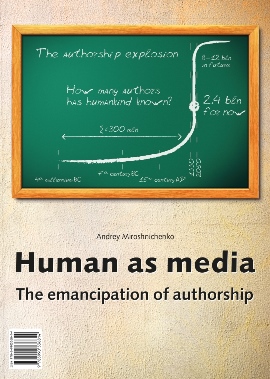
- Human as media. The emancipation of authorship (2014)

 Human as Media