Social media increasingly serve not to facilitate conversations but to sort out everyone’s attitude toward the most pressing issues. The wrong response to someone’s hard-fought truth is punished by reciprocal aggression and various forms of ostracism. An excerpt from the chapter “The Viral Inquisitor” in The Viral Inquisitor and other essays on postjournalism and media ecology.
Digital media not only compressed the time and space that once separated people but also enabled a new language: digital speech, which has traits of both oral and written communication. Like oral speech, it permits the instant exchange of replies; like writing, it leaves behind a record and can be transmitted in time and space. These features mean that people’s spontaneous and mostly emotive efforts to establish their social statuses in conversation are no longer transient. The reactions of millions of people are accumulated, spread, and displayed to everyone else.
This new type of conversation, digital orality, has its benefits. It allows socialization at an unprecedented pace and scale. The Viral Editor still delivers the most relevant information to everyone. However, the ease of exchanging digital speech has shifted the focus of mass communication from reflections to reflexes, from substance to attitude. Social media demand that everyone relate to others, to their ideas, to their troubles and achievements – indeed, to their very existence.

Social media increasingly serve not to facilitate conversations but to sort out everyone’s attitude toward the most pressing issues of the day. The wrong response to someone’s hard-fought truth is punished by reciprocal aggression and various forms of ostracism.
Under these environmental conditions, affected by the algorithms and instantaneous exchange of digital reflexes, the Viral Editor morphed into the Viral Inquisitor, as Martin Gurri suggested calling it at a recent workshop. If the Viral Editor required everyone to participate in content selection, the Viral Inquisitor demands from everyone solidarity with the most widely held views of others.
The Viral Inquisitor is a relentless tormentor. British anthropologist Robin Dunbar famously hypothesized that the human brain can maintain stable social relationships with 120 to 150 individuals, the size of a tribal group or a village. Social media override Dunbar’s number, burdening users with connections more numerous than what we can handle. Excessive social connections make people feel compelled to know hundreds of strangers, whose digital existence intrudes upon their personal space – their screens.
Through the same mechanisms that the Viral Editor used to customize content for everyone, the Viral Inquisitor gathers identity signals of others and delivers them precisely to those most likely to react. You may choose not to react, but when you eventually or accidentally react with a click, or even a longer pause in scrolling down, you fall into a trap of further customization and better-customized identity signalling. Sophisticated algorithms ensure that the Viral Inquisitor notes everyone’s inclinations and preferences. The user can’t escape from being exposed to the identity signals of others and their persisting demands for affirmation. If you react wrongly, you are guilty.
This makes the Viral Inquisitor a much more effective warden than the notorious Big Brother. The sins and thoughtcrimes of everyone get delivered precisely to those who can be alarmed and enraged. No KGB is capable of such all-pervasive control over everyone’s wrongdoings and wrongthink. The Viral Inquisitor is the collective high priest of cancel culture.
The digital inquisition of truth
But perhaps the worst element of this transformation is the way it abets the emergence of post-truth. A persistent interrogator, the Viral Inquisitor extracts users’ testimonies and checks them against the truths held by others. The Viral Inquisitor changes the way propositions are verified, challenging our very epistemology of truth.
Before literacy, a truth was confirmed by how well it comported with nature and its divine moving forces. Polytheism was the natural science of oral culture. To deal with nature, gods, and one another, humans made respective arrangements with all these. Better arrangements lasted longer and conferred better benefits on their participants – practice was the criterion of truth, to quote Marx with his materialism. Preliterate truths were conditional; they were negotiated and tested by outcomes.
Literacy separated truth from practice. It became possible to inscribe truth, to carry it on through time and space, amplifying its sacred meaning until it gained the status of the ultimate law. The so-called alphabet effect,[i] according to physicist and media theorist Robert K. Logan, went further. The linear code of abstract signs for meaningless sounds enabled abstract logic, monotheism, and the concept of absolute truth. The multitude of practical truths held by varying groups in various situations was replaced by one moral law: that of God. The truth inscribed in the Book was unified. At different times, the Book was the scripture, the code of laws, the textbook; all contained absolute truth. In written culture, truth belongs to nobody but solely to the highest authority and can only be interpreted.
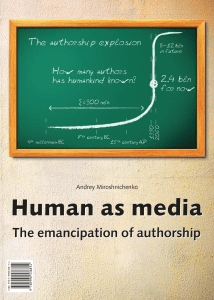
In the same way that digital speech combines oral and written speech, digital orality combines the preliterate and literate epistemologies of truth. The emancipation of authorship by the Internet undermined preexisting authorities, including the authority of absolute truth. As millions of people entered the business of meaning-production, the broadcasting of absolute truth lost its monopoly. Scriptures and textbooks forfeited their power. The caste of priest-interpreters was replaced by multiple crowd-sourced interpretations of the world. People now vote for truth with clicks. Truth is again up for negotiation.
In the digital world, the truth of a given statement can be confirmed – again – by the practical outcomes that it generates. But these practical outcomes now happen in digital, not physical, reality. Since digital reality presents the world through the views of others, the truth of everyone is defined by the truths of others. Social media have legitimized crowd-sourced truths as a side effect of their design. Since online engagement is built on responses, the Viral Inquisitor demands that everyone relate to the truths of others.
People still select and deliver important content to one another, but content no longer takes the form of logical statements with truth-values that can be tested against the absolute truth. Instead, content becomes a vehicle for the expression of emotional attitudes. The automatic means of reaction, such as likes and reposts, on social media do not require logical deliberation. Under such a design, the point is to express the right attitude, not to convey true information.
Wrong information is tolerated when it allows the right attitude. And the right information is ignored if it supports the wrong attitude. Confirmation bias is embedded in the design: we trust what we “like.” This is why fake news victoriously marches across the Internet. The “truth” that has already been verified by viral distribution is too good to be fact-checked. The problem with fake news is not that it’s hard to refute – rebutting it is often easy. The problem is that people like fake news. They vote for it with their clicks and their likes.
Under such truth-verification conditions, the truth of any story remains a matter of probabilities, but judgments are certain and real; they are “proved” by dissemination, and they are voted for and verified, in lieu of the story itself. Conspiracies thrive when truth gives way to attitudes and groupthink. Conspiracies gain as much power as is lost by objective truth.

Social media have completed the epistemological mutation of truth into post-truth. One can mourn absolute truth and the culture based on it, but society must learn to adapt to the conditions of crowd-sourced, negotiated truth. Digital truth’s persuasiveness is more important than its rationale.
The Viral Inquisitor possesses algorithms that detect and report our preferences. It forces us into compliance and enables the next stage of digital development – the society of social scoring. The algorithms are good (and getting better) at detecting and tabulating our attitudes. For now, they decide what content to show us in accordance with our attitudes. Soon, they may use knowledge of our attitudes to tell us what to do. The viral inquisition will evolve accordingly. For now, the Viral Inquisitor still acts through the executive power of corporations and communities. Soon, the algorithms may merge with government power. Social scoring would then become the Viral Inquisitor’s tool of discipline and punishment.
An excerpt from the chapter “The Viral Inquisitor” in The Viral Inquisitor and Other Essays on Postjournalism and Media Ecology.
(The essay “The Viral Inquisitor” was first published in City Journal.)
See also books by Andrey Mir:
- Digital Future in the Rearview Mirror: Jaspers’ Axial Age and Logan’s Alphabet Effect (2024)
- Postjournalism and the death of newspapers. The media after Trump: manufacturing anger and polarization (2020)
- Human as media. The emancipation of authorship (2014)


[i] Logan, Robert K. (1986). The Alphabet Effect: The Impact of the Phonetic Alphabet on the Development of Western Civilization. See also: Alphabet effect. Wikipedia.
Categories: Digital Future in the Rearview Mirror, Digital orality, Emancipation of Authorship, Viral Editor, Viral Inquisitor
 Human as Media
Leave a comment