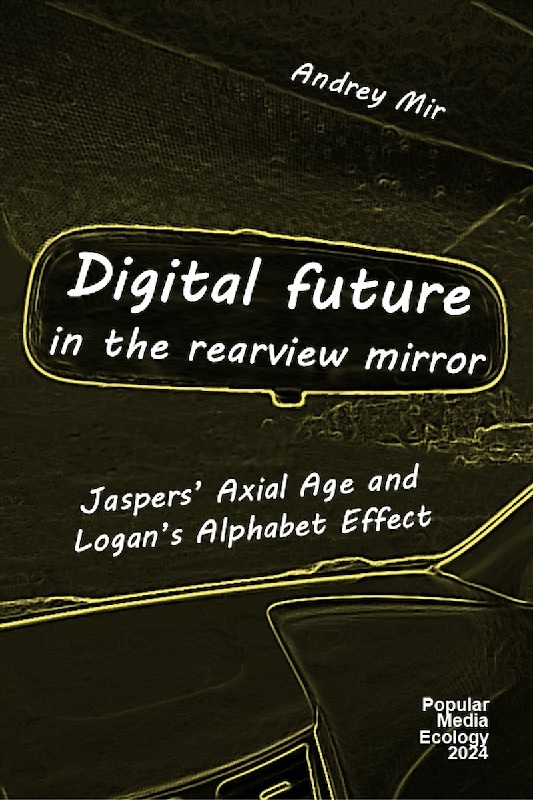
As a state of mind, orality preceded literacy, but nothing preceded orality. Humans might have “invented” literacy, but they did not invent orality. It came with the factory settings of Homo sapiens. A section from Chapter “The features of orality” in just published Digital Future in the Rearview Mirror: Jaspers’ Axial Age and Logan’s Alphabet Effect.
For a literate mind, the true nature of orality often remains in a blind spot. Orality is most commonly associated with folk songs, ballads, nursery rhymes, and so on. After giving it some thought, most people will find that orality is illiteracy – something incomplete in comparison to what literate individuals possess. To use Ong’s metaphor, this view of orality is “like thinking of horses as automobiles without wheels.”[1] Recognizing orality as not folk songs or illiteracy but the innate state of mind requires some effort and expertise.
As a state of mind, orality preceded literacy, but nothing preceded orality. Humans might have “invented” literacy, but they did not invent orality. It came with the factory settings of Homo sapiens as soon as implements and speech separated humans from animals.
Ong expressed a similar idea when he said that the world of sound is “the natural habitat of language.”[2] But our concept of language is too “linguistic,” too focused on verbal communication to understand the true nature of language in the conditions of orality. According to Ong,
Fully literate persons can only with great difficulty imagine what a primary oral culture is like, that is, a culture with no knowledge whatsoever of writing or even of the possibility of writing.[3]
Frankly, it is similarly difficult for us to recognize what literacy is. Just as orality is often reduced to folk songs or illiteracy, so is literacy, in lay perception, often reduced to the ability to read and write. The fact that literacy is a way of seeing the world and operating in it is hard to comprehend. “The fish is not aware of the water” was one of the favourite proverbs of Marshal McLuhan. To recognize its environment, the fish must be pulled out into the antienvironment – the air.
Since we live in an environment shaped by literacy, it is invisible for us – we do not know its characteristics. Even less do we know about the environment of orality. However, the absence of reflection on literacy or orality does not automatically imply the absence of experience. We surely have experience with literacy as a state of mind and a social order, but we also have experience with orality – an experience that is not only inherited but also lived through personally.
Some communities within even highly literate societies continue oral traditions dating millennia back to the time of primary orality. A pure example of this is the mafia. In other situations, people also revert to orality. This happens when social dynamics are regulated by means of oral communication. Collectives of hobbyists, fraternities, expeditions, field worker groups, political debates, prisons, and the entire Gulag Archipelago, along with some other social or professional groups or activities, still exhibit the features of residual orality to varying degrees.
Even a friends’ gathering retrieves some features of orality as soon as people put down their cellphones and become immersed into oral practices, such as small talk or storytelling. And family reunions – certainly. They had not changed much since those evenings spent by families in caves around campfires and until the arrival of the TV at the family hearth.
The residual orality of literate people, however, gives only a glimpse of insight into the orality of people who never knew writing – such is the definition of primary orality suggested by Walter Ong. Contemporary residual orality, of course, differs significantly from the primary orality of preliterate people.
For a literate person, the comprehension of the oral mindset might be hard. For an oral person, the comprehension of the literate mindset is impossible. So, literate people have some advantage in understanding both conditions; they can deconstruct, with some effort, both literacy and orality.
The trick is that orality can only be explored in its opposition to literacy and vice versa. They are perceivable only together as environment and antienvironment. To each other, orality and literacy are distorting mirrors in which their specifications can be seen through distortions. That is why the literate bias not only prevents but also helps to understand orality – after acquiring an awareness of what the literate bias itself is, of course.
Interestingly, the need for such dichotomic reflection was driven by changes in media. According to the already quoted Ong’s observation,
Our understanding of the differences between orality and literacy developed only in the electronic age, not earlier. Contrasts between electronic media and print have sensitized us to the earlier contrast between writing and orality.[4]
Another significant feature of this dichotomy is that, in a culture with writing and general education, literacy develops rapidly, perhaps within the span of several generations. Orality developed during tens of thousands of years. Orality as a state of mind and culture started with oral speech as a communication device – that is still with us – and transformed it into a complex device of memorization. The memorizing function of orality has been replaced and suppressed by literacy and is mostly lost, though some residual forms of it (such as proverbs or idioms) persist and are now even being retrieved by digital orality in the forms of memes.
From Digital Future in the Rearview Mirror: Jaspers’ Axial Age and Logan’s Alphabet Effect.
See also books by Andrey Mir:
- Digital Future in the Rearview Mirror: Jaspers’ Axial Age and Logan’s Alphabet Effect (2024)
- Postjournalism and the death of newspapers. The media after Trump: manufacturing anger and polarization (2020)
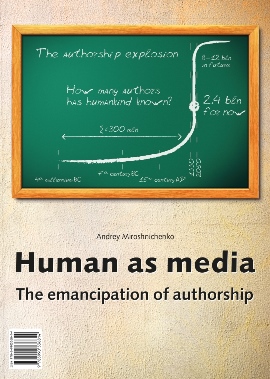
- Human as media. The emancipation of authorship (2014)

[1] Ong, Walter. (2002 [1982]), Orality and Literacy, p. 12.
[2] Ong, Walter. (2002 [1982]), Orality and Literacy, p. 8.
[3] Ong, Walter. (2002 [1982]), Orality and Literacy, p. 31.
[4] Ong, Walter. (2002 [1982]), Orality and Literacy, p. 2.
Categories: Digital Future in the Rearview Mirror, Media ecology
 Human as Media
Leave a comment