“If the news is important, it will find me,” said Brian Stelter in 2008. People inevitably learn the news that matters to them. Neither effort nor payment is required. When the scarcity of content reverses to abundance, people no longer hunt for news—news hunts for people.
A chapter from The Digital Reversal. Thread-Saga of Media Evolution.
With the internet, news reliability might have degraded, but overall, people became better informed. This flipped the value in content production: news stopped being a commodity and became bait to attract users for other purposes—mainly engagement.
It wasn’t a tragedy for the news media yet, as they had always used news to attract audiences and sell them to advertisers. The real issue was that advertisers moved to digital platforms too, where they were provided with much better service than the media could ever offer.
First, classifieds moved to digital, taking a third of newspapers’ revenue with them. Corporate ads followed. By 2014, ad revenue in newspapers had dropped below 1950 levels. The entire economic foundation of the press vanished in just a decade.
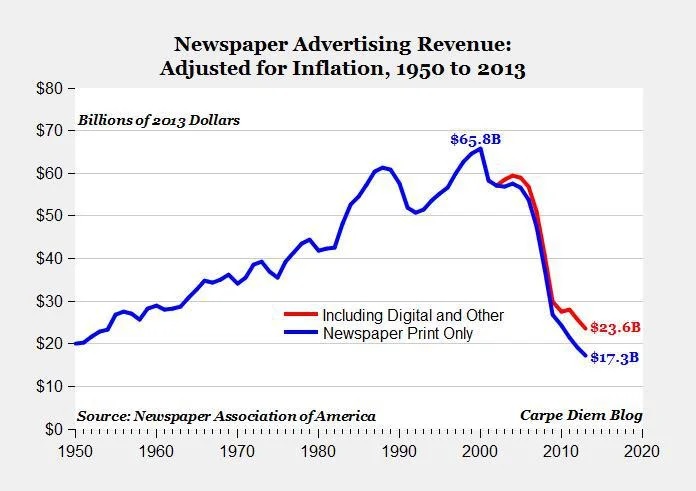
The decline of ad revenue in newspapers. Source: The Newspaper Association of America. [i]
The collapse of advertising was a catastrophe. Throughout the 20th century, the media were 70–80% funded by ads. Journalism was built on the advertising model. When ad revenue dropped below what the media could survive on, further reversals became inevitable.
The first was the reversal of the business model itself. In 2014-2015, newspapers’ ad revenue dropped below circulation revenue. Not because subscriptions or copy sales grew—they stalled or declined as well. But ad revenue declined faster.
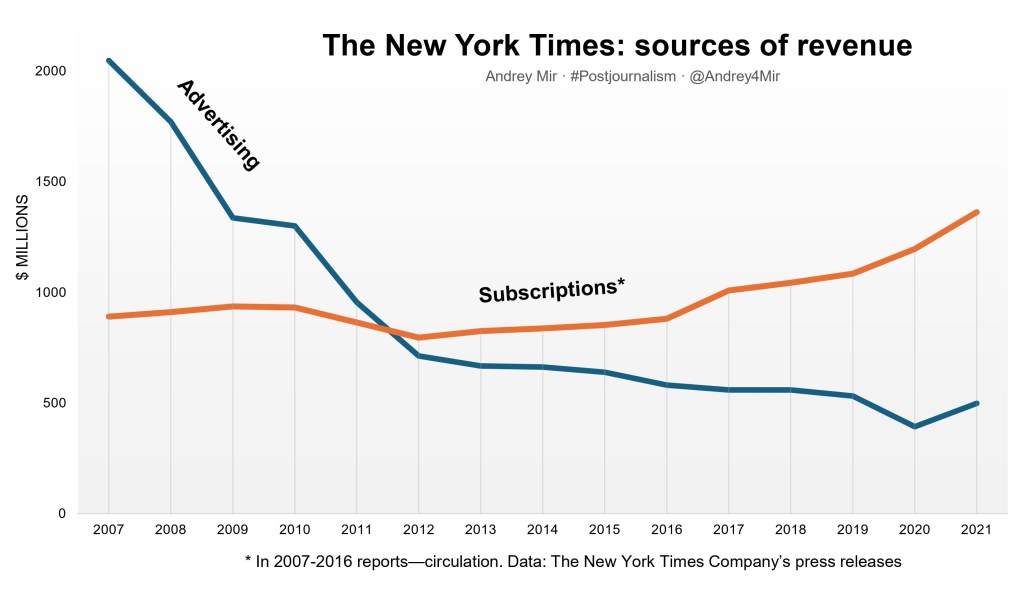
(Experts know that later the New York Times demonstrated subscription growth unmatched in the industry, but it had little to do with subscriptions to news. Most of the growth came from other products and packages.)
Similar dynamics hit TV and radio—ad money was diverted to digital platforms. As a result, the business model of news media flipped from predominantly relying on ads to relying more on readers/viewers. The flip happened in the early 2010s everywhere.
***
Unrecognized by the public and the industry, the business reversal changed newsrooms’ approaches and mentality. After some awkward attempts to replace lost revenue with auxiliary businesses, the media returned to their point of origin: the readers.
As everything was moving online—it was the period of the Digital Rush—the media tried to keep up. They started chasing digital audiences, which at the time consisted mostly of the educated, urban, young, and progressive. Most MSM targeted them as potential digital subscribers.
This is where another unnoticed reversal happened: instead of covering news for a broad audience, as they did under the advertising model, news media started catering to a narrow group of digital progressives. The reversal in business model led to an ideological reversal.
Attempts to attract early digital audiences radically changed news coverage, but no business came out of it. Progressives were truly progressive—they didn’t consume news from old media. Most paywalls, a popular trend in the industry in 2011–12, failed.
The environment itself delivered the news. One didn’t even need to visit media websites—news outlets posted their best headlines in our newsfeeds. With friends’ comments selected by the Viral Editor, it provided a fairly reliable picture of the day.

However, if something worrisome happened, people still needed someone authoritative to confirm how bad it was. Old media suited the role of bad-news notaries very well. They got the prompt and flipped news supply into news validation.
***
In the meantime, the dominance of the progressive agenda in MSM frustrated conservatives, who adopted social media by the mid-2010s and politicized, too. Their anxiety about being underrepresented in the media built up. The time came for Trump to enter the scene.
Multiple media effects overlapped and cascaded. The flip from advertising to seeking subscriptions, combined with the media’s demographic tilt toward progressives, not only fueled popular demand for Trump but also prepared the media for the business of bad-news validation.
The media began selling Trump—first as amusement, then as a threat to democracy. The Trump scare proved to be a valuable commodity, leading to the so-called Trump bump, a short period of success for some of the largest mainstream media.
To profit from the Trump bump, a whole new approach was needed. Since news media could no longer sell news or ads, they began soliciting subscriptions as donations to the cause of democracy. Advertising motives also shifted—from commercial to political.
News validation, targeting digital progressives, and soliciting support for a cause required the media to take political and moral stances. This led to a reversal of 20th-century journalism and a retrieval of the party press’s “business model” from the 18th–19th centuries.
Selling moral stances reversed nearly everything in the media. Journalism flipped into activism. The standards reversed too: the old standards of objectivity and impartiality were labeled as bothsidesism and the “view from nowhere,” and openly rejected.
The morality race is like the Overton window: what seemed “too much” yesterday becomes a “must” today. Just yesterday, journalists rigorously separated facts from opinions; today, many see themselves as counselors in a nationwide re-education camp.
***

To encourage people’s support for the media protecting democracy, the threat to democracy was essential. The media were incentivized to amplify and dramatize issues that affirmed their role as champions. They needed to fuel public concern.
As the media needed to amplify people’s frustration for profit, it spiraled into the amplification of extremes and, eventually, polarization. The outraged and polarized audience was a side effect of this business model.
After embracing activism and changing its professional standards, journalism completed its mutation into postjournalism. Journalism strove to depict reality as-it-is. Postjournalism projects reality as-it-should-be.
Journalism wanted its picture to match the world; postjournalism wants the world to match its picture. The ad-driven media manufactured consent. The reader-driven media manufacture anger. The former served consumerism; the latter serve polarization.
Postjournalism did not help the media save their business. But switching from selling news and ads to soliciting support for their cause was the only viable option anyway. In the meantime, public trust in the media dropped to a historic low.
Reed more in: The Digital Reversal. Thread-Saga of Media Evolution.
Other books by Andrey Mir:
- The Digital Reversal. Thread-saga of Media Evolution. (2025)
- The Viral Inquisitor and other essays on postjournalism and media ecology (2024)
- Digital Future in the Rearview Mirror: Jaspers’ Axial Age and Logan’s Alphabet Effect (2024)
- Postjournalism and the death of newspapers. The media after Trump: manufacturing anger and polarization (2020)
- Human as media. The emancipation of authorship (2014)


Categories: Decline of newspapers, Digital Reversal, Future of journalism, Media ecology, Polarization, Postjournalism and the death of newspapers
 Human as Media
Leave a comment